

JMERC
Owner
Janbazan Medical and Engineering Research Center (JMERC) is the owner of IJWPH.

1.0
Cite Score 2025
SJR: 0.129 / SNIP: 0.140
Volume 18, Issue 2 (2026)
Iran J War Public Health 2026, 18(2): 207-212 |
Back to browse issues page
Article Type:
Subject:




Ethics code: IR.CFU.REC.1405.001
History
Received: 2026/05/15 | Accepted: 2026/07/2 | Published: 2026/07/19
Received: 2026/05/15 | Accepted: 2026/07/2 | Published: 2026/07/19
How to cite this article
Tolabi-Mazraeno A. Developing Effective Strategies to Enhance Veterans' Participation in Sports Activities. Iran J War Public Health 2026; 18 (2) :207-212
URL: http://ijwph.ir/article-1-1755-en.html
URL: http://ijwph.ir/article-1-1755-en.html
Download citation:
BibTeX | RIS | EndNote | Medlars | ProCite | Reference Manager | RefWorks
Send citation to:


Rights and permissions
BibTeX | RIS | EndNote | Medlars | ProCite | Reference Manager | RefWorks
Send citation to:

Authors
A. Tolabi-Mazraeno *
Department of Physical Education, Farhangian University, Tehran, Iran
Full-Text (HTML) (3 Views)
Introduction
Considering the expansion of modern, mechanized lifestyles that have led to increased physical weakness, mental and psychological disorders, and a growing detachment from ethical and human values, the need for regular physical activity is strongly emphasized [1]. Moreover, the rapid development of information technology has further contributed to sedentary behaviors across societies, turning physical inactivity into a global public health challenge [2]. Physical inactivity is recognized as a major cause of disability and various diseases in communities [3], and nearly two million deaths annually are attributed to insufficient physical activity.
According to World Health Organization reports, inactivity ranks among the ten leading causes of mortality worldwide [4]. Among different population groups, the importance of physical activity is particularly critical for war veterans, as their physical conditions, mobility limitations, and the long-term consequences of injuries sustained during wartime place them at a significantly higher risk of reduced physical activity [1]. This group requires structured exercise programs tailored to their physical limitations to maintain independence, prevent muscular atrophy, improve cardiorespiratory function, and reduce secondary complications associated with inactivity. Therefore, increasing their participation in sports activities plays a pivotal role in enhancing both their physical and psychological well-being [5]. Through appropriate health-oriented exercise programs and physical activity interventions, the quality of life of veterans can be effectively improved, as physical impairments—especially among veterans with more severe mobility limitations—may seriously jeopardize their health and daily functioning [6].
Sports participation offers numerous physical and psychological benefits for veterans, such as maintaining and improving motor health, supporting rehabilitation, enhancing self-confidence and body image, and reducing depression and irritability [7]. Increased sports participation also strengthens the immune system, reduces stress in veterans [8], and mitigates aggressive behaviors, ultimately improving their quality of life and even reducing the likelihood of certain diseases, including prostate cancer [9]. For example, Cho demonstrated that equine-assisted activities improved psychological stability among veterans, and that fostering positive attitudes toward physical activity can lead to healthier behavioral patterns and greater willingness to engage in exercise [10]. Given these considerations, the role of physical activity among veterans is highly significant, and enhancing their participation should be regarded as a social and health-related necessity. Accordingly, to facilitate effective planning for sports programs aimed at veterans in Yazd City and to improve their health through appropriate exercise interventions, the researchers sought to identify and rank the factors influencing veterans’ participation in sports activities.
This study is important because identifying the key factors influencing sports participation among veterans and individuals with sacrificial service can provide the necessary scientific evidence for policymakers and sports managers to design targeted interventions. In addition, understanding these factors helps optimize resource allocation and develop effective strategies to overcome barriers to participation in this vulnerable group. Ultimately, the findings of this research may improve veterans’ quality of life and promote their sustained engagement in physical activities.
Takata et al., in a study examining the relationship between health, physical fitness, and quality of life among veterans in Japan, found that individuals who maintained and enhanced their fitness levels over time enjoy a higher quality of life [9]. Huang & Brad [11] declare that financial incentives and economic support markedly enhance participation in physical activity. Hallmann et al. compared the public and nonprofit sectors in promoting mass sports participation and concluded that nonprofit sports clubs are more effective than government facilities in motivating individuals to engage in mass sports activities [12]. In another study, Sadeghzadeh & Razavi explored motivations for participating in sports activities among the citizens of Yazd, finding that managerial, cultural, and preventive/therapeutic dimensions are among the most influential factors in sports participation [1].
Furthermore, Yen & Lin demonstrated that increased engagement in sports activities enables veterans to achieve higher scores in social, mental, and emotional functioning than other inactive individuals, thereby improving their overall quality of life [13]. Mohammadi & Keshkar conducted a comparative study on strategies for promoting elderly sports participation in selected countries, identifying several key strategies, including developing comprehensive management plans, fostering a pro-exercise culture, creating age-friendly environments, improving accessibility, and promoting health literacy [14]. In addition, Durmusoglu et al. emphasized that several structural, motivational, and environmental barriers significantly reduce participation in physical activities among individuals, highlighting the importance of addressing these constraints to improve participation in sports programs [2]. Similarly, Liu & Zhong found that participation in sports activities not only enhances individuals’ subjective well-being but also improves mental health outcomes, with class identity and health status playing mediating roles in this relationship [6].
Collectively, previous studies have shown that enhancing sports participation and promoting sports development depend on a wide range of health, managerial, economic, cultural, and environmental factors. In this regard, sport management studies have identified and prioritized barriers to industrial support for sport organizations, emphasizing the importance of evidence-based decision-making for strategic planning and policy development [15]. Furthermore, financial sponsorship has been shown to enhance brand equity and organizational performance in sport organizations [16]. Other studies have also highlighted the importance of identifying and prioritizing barriers to privatization in the soccer industry [17] and employee participation in sport activities [18]. In addition, research has identified the major challenges and strategies for the development of sport for all [19], while similar evidence has demonstrated the value of prioritizing barriers to swimming development as a basis for effective sport development planning [20].
This study aimed to identify the factors influencing sports participation among veterans, validate the study’s conceptual model using structural equation modeling, and prioritize the identified factors.
Instrument and Methods
This applied descriptive-survey study was conducted in Yazd city in 2025 using a mixed-methods approach with an exploratory sequential design, in which qualitative findings were first used to develop the quantitative phase of the research. The research process was carried out in two distinct but integrated qualitative and quantitative phases.
In the qualitative phase, the study used an exploratory qualitative approach to identify the key strategies and factors affecting veterans’ participation in sports activities in Yazd City and to form the basis of the initial conceptual framework. Participants were recruited through purposive sampling supported by snowball sampling. Eligibility criteria required participants to have at least 10 years of experience in veterans’ sports, academic expertise in physical education or sports management, and active involvement in veterans’ sports programs or relevant policymaking processes. The sample included sports experts in Yazd, scholars in physical education with experience in veterans’ issues, and veteran athletes with extensive sports backgrounds. Interviews were conducted until data saturation was achieved, meaning that additional interviews no longer produced new themes. This was reached after 12 in-depth semi-structured, face-to-face interviews. Each interview lasted about 45–60 minutes, was audio-recorded with participants’ consent, and was transcribed verbatim for subsequent analysis. Data analysis was performed using thematic analysis, which involved open coding, axial coding, and selective coding to extract main themes and sub-themes related to veterans’ sports participation. Based on the qualitative findings, an initial pool of indicators was extracted and refined through expert review, which was then used to develop the researcher-made questionnaire for the quantitative phase.
The quantitative phase involved 4,420 veterans residing in Yazd City in 2025. The sample size was determined to be 351 participants based on the Krejcie and Morgan table. To ensure the representativeness of the population, a simple random sampling technique was employed.
Data were collected using a structured questionnaire developed based on the qualitative findings and the literature review. The questionnaire consisted of two sections, including demographic information and items measuring factors influencing sports participation among veterans. The content validity of the questionnaire was assessed by 10 experts in sports management, and necessary revisions were applied based on their feedback. Reliability was evaluated using Cronbach’s alpha coefficient, which confirmed acceptable internal consistency (α=0.79). Written informed consent was obtained from all participants.
The Friedman test was used to rank the identified factors based on their importance. Prior to analyses, the normality of the data distribution was assessed using the Kolmogorov-Smirnov test, and the distribution of data related to factors influencing sports participation among veterans in Yazd was normal. All quantitative analyses were performed using SPSS 27.
Findings
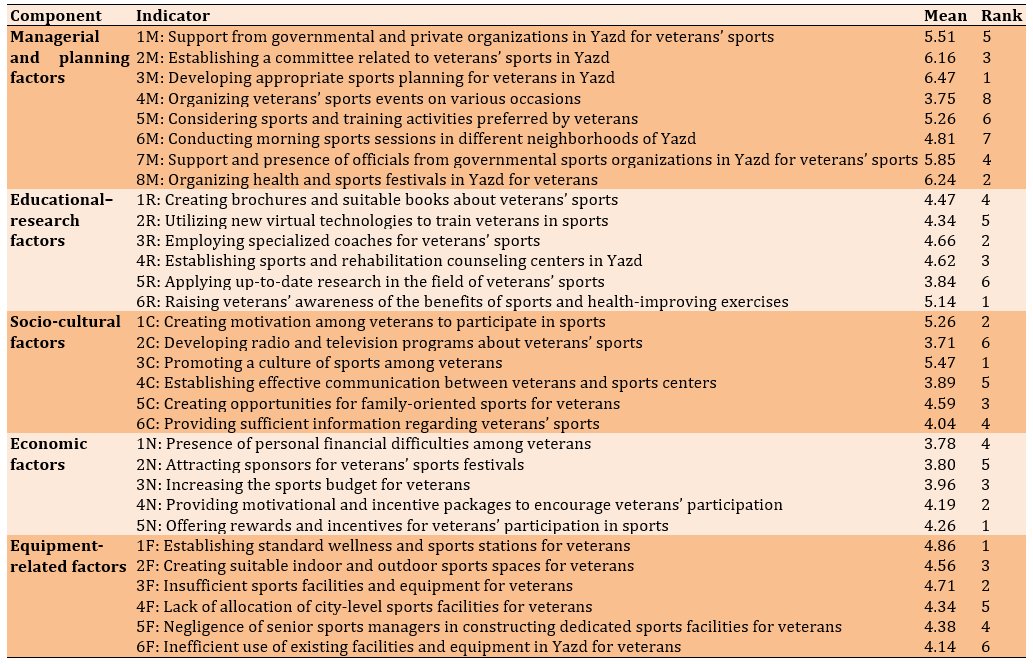
Among managerial and planning factors, “developing appropriate sports planning for veterans in Yazd” had the highest impact. Among educational–research factors, “raising veterans’ awareness of the benefits of sports and health-improving exercises” was the most influential. Among socio-cultural factors, “promoting a culture of sports among veterans” played the greatest role. Among economic factors, “offering rewards and incentives for veterans’ participation in sports” was most significant. Finally, among equipment-related factors, “establishing standard wellness and sports stations for veterans” had the highest impact (Table 1).
The Friedman test produced a chi-square value of 284.536 with N=351, df=4 (p<0.05). Therefore, there was a significant difference between the mean ranks of the factors influencing sports participation among veterans in Yazd. Managerial and planning had the highest priority (mean rank 5.12, rank 1; factor loading=0.73), followed by the economic component (mean rank 4.19, rank 2; factor loading=0.61). This was followed by the socio-cultural component (mean rank 3.75, rank 3; factor loading=0.84), the educational–research component (mean rank 3.63, rank 4; factor loading=0.71), and finally the equipment-related component (mean rank 3.18, rank 5; factor loading=0.77).
Table 1. Prioritization of the indicators
Discussion
This study aimed to propose effective strategies to increase participation in sports activities to improve the health of veterans in Yazd City. The most important factors influencing sports participation among veterans in Yazd City were, in order, managerial and planning factors, economic factors, and socio-cultural factors. Thus, structural and organizational dimensions play a more fundamental role than individual or environmental constraints in determining veterans’ participation in sports activities. These findings are consistent with Mohammadi & Keshkar [14], who emphasize that strategic planning, the development of comprehensive management frameworks, and the promotion of a sports culture are key determinants of mass sports participation. Another study recommends prioritizing the barriers to the support of Yazd ceramic and tile companies for soccer clubs using the Analytic Hierarchy Process [15]. Zarei Mahmoudabadi et al. [16] reported that structured planning and strategic management markedly improve participation outcomes in sports programs.
Savari et al. [21] report that managerial planning and cultural promotion through the media are among the most influential factors in developing sports participation systems. Furthermore, our results are in line with those of Hallmann et al. [12], who found that well-structured organizational systems, particularly in nonprofit sports organizations, are more effective in encouraging participation compared to purely governmental systems. This supports the present finding that managerial and planning structures are the most influential factor in enhancing veterans’ sports participation. In contrast, the findings differ from those of Araghi & Kashef [19], who reported that the lack of sports facilities is the main barrier to sports participation in Iran. This inconsistency may be attributed to differences in target populations, as we focused specifically on veterans, who may be more influenced by motivational, managerial, and economic factors than by infrastructural constraints. Regarding the managerial and planning dimension, developing appropriate sports planning for veterans was the most important sub-factor. This finding is consistent with that of Razavi et al. [22].
The second most important factor identified was the economic factor. This result aligns with Huang & Brad [11], who report that financial incentives and economic support significantly increase participation in physical activity, as well as Liu & Zhong [6], who demonstrate that sports participation is closely linked to perceived socio-economic benefits and subjective well-being. Reward systems and incentive packages were the most influential sub-components of this factor. The third factor was socio-cultural. This finding is supported by Liu and Zhong [6], who emphasize the role of awareness, cultural promotion, and social motivation in increasing sports engagement. Similarly, Seyed Ameri & Jameei [23] found that mass media and cultural reinforcement play a significant role in shaping individuals’ attitudes toward sports participation. Promoting a sports culture and increasing motivation were identified as key sub-factors. Overall, improving sports participation among veterans requires an integrated approach that combines managerial planning, financial support, and socio-cultural development.
It is recommended that sports authorities and policymakers in the city of Yazd prioritize the development of comprehensive, evidence-based strategic programs aimed at increasing veterans’ participation in sports activities. In particular, managerial and planning structures should be strengthened through the establishment of specialized committees and the reinforcement of coordinated inter-organizational collaboration. It is also necessary to implement financial support mechanisms, including incentive systems, opportunities to attract sponsors, and increased budget allocation for veterans’ sports programs, to reduce economic barriers and enhance participation. In addition, cultural and media interventions, such as awareness campaigns, television and radio programs, and community-based sports events, should be expanded to promote positive attitudes toward physical activity among veterans and to institutionalize a culture of regular sports participation.
This study has several limitations that should be considered when interpreting the results. First, this research was conducted exclusively among veterans residing in the city of Yazd; therefore, generalizability to other regions or populations should be made with caution. Second, data collection was based on self-report questionnaires, which may be influenced by response bias and social desirability tendencies. Third, the cross-sectional nature of the study limits the ability to infer causal relationships between the identified factors and sports participation. Finally, this study primarily focused on perceptual factors affecting participation and did not directly measure behavioral changes over time.
In future studies, it is recommended that the geographical scope be expanded by including veterans from other provinces or national-level samples to enhance the generalizability of the findings. It is also suggested that longitudinal or experimental research designs be employed to examine causal relationships between managerial, economic, and socio-cultural factors and sports participation over time. Furthermore, future research could investigate additional psychological parameters, such as motivation, self-efficacy, and perceived barriers, to provide a more comprehensive understanding of veterans’ sports participation behavior. Finally, conducting comparative studies between veterans and other special populations may offer deeper insights into the determinants of physical activity across different groups.
Conclusion
The sports participation of veterans in Yazd is primarily influenced by managerial and planning factors, followed by economic and then socio-cultural factors.
Acknowledgments: We sincerely extend our heartfelt gratitude to all the veterans of Yazd City for their invaluable participation and cooperation in this research. We also wish to thank the esteemed officials of the Foundation of Martyrs and Veterans Affairs of Yazd Province for their support.
Ethical Permissions: The study received approval from the Research Commission of Yazd University, with ethics code IR.YAZD.REC.1403.014.
Conflicts of Interest: There are no conflicts of interest.
Authors' Contribution: Tolabi-Mazraeno A (First Author), Introduction Writer/Methodologist/Main Researcher/Discussion Writer/Statistical Analyst (100%)
Funding/Support: This study was not financially supported.
Considering the expansion of modern, mechanized lifestyles that have led to increased physical weakness, mental and psychological disorders, and a growing detachment from ethical and human values, the need for regular physical activity is strongly emphasized [1]. Moreover, the rapid development of information technology has further contributed to sedentary behaviors across societies, turning physical inactivity into a global public health challenge [2]. Physical inactivity is recognized as a major cause of disability and various diseases in communities [3], and nearly two million deaths annually are attributed to insufficient physical activity.
According to World Health Organization reports, inactivity ranks among the ten leading causes of mortality worldwide [4]. Among different population groups, the importance of physical activity is particularly critical for war veterans, as their physical conditions, mobility limitations, and the long-term consequences of injuries sustained during wartime place them at a significantly higher risk of reduced physical activity [1]. This group requires structured exercise programs tailored to their physical limitations to maintain independence, prevent muscular atrophy, improve cardiorespiratory function, and reduce secondary complications associated with inactivity. Therefore, increasing their participation in sports activities plays a pivotal role in enhancing both their physical and psychological well-being [5]. Through appropriate health-oriented exercise programs and physical activity interventions, the quality of life of veterans can be effectively improved, as physical impairments—especially among veterans with more severe mobility limitations—may seriously jeopardize their health and daily functioning [6].
Sports participation offers numerous physical and psychological benefits for veterans, such as maintaining and improving motor health, supporting rehabilitation, enhancing self-confidence and body image, and reducing depression and irritability [7]. Increased sports participation also strengthens the immune system, reduces stress in veterans [8], and mitigates aggressive behaviors, ultimately improving their quality of life and even reducing the likelihood of certain diseases, including prostate cancer [9]. For example, Cho demonstrated that equine-assisted activities improved psychological stability among veterans, and that fostering positive attitudes toward physical activity can lead to healthier behavioral patterns and greater willingness to engage in exercise [10]. Given these considerations, the role of physical activity among veterans is highly significant, and enhancing their participation should be regarded as a social and health-related necessity. Accordingly, to facilitate effective planning for sports programs aimed at veterans in Yazd City and to improve their health through appropriate exercise interventions, the researchers sought to identify and rank the factors influencing veterans’ participation in sports activities.
This study is important because identifying the key factors influencing sports participation among veterans and individuals with sacrificial service can provide the necessary scientific evidence for policymakers and sports managers to design targeted interventions. In addition, understanding these factors helps optimize resource allocation and develop effective strategies to overcome barriers to participation in this vulnerable group. Ultimately, the findings of this research may improve veterans’ quality of life and promote their sustained engagement in physical activities.
Takata et al., in a study examining the relationship between health, physical fitness, and quality of life among veterans in Japan, found that individuals who maintained and enhanced their fitness levels over time enjoy a higher quality of life [9]. Huang & Brad [11] declare that financial incentives and economic support markedly enhance participation in physical activity. Hallmann et al. compared the public and nonprofit sectors in promoting mass sports participation and concluded that nonprofit sports clubs are more effective than government facilities in motivating individuals to engage in mass sports activities [12]. In another study, Sadeghzadeh & Razavi explored motivations for participating in sports activities among the citizens of Yazd, finding that managerial, cultural, and preventive/therapeutic dimensions are among the most influential factors in sports participation [1].
Furthermore, Yen & Lin demonstrated that increased engagement in sports activities enables veterans to achieve higher scores in social, mental, and emotional functioning than other inactive individuals, thereby improving their overall quality of life [13]. Mohammadi & Keshkar conducted a comparative study on strategies for promoting elderly sports participation in selected countries, identifying several key strategies, including developing comprehensive management plans, fostering a pro-exercise culture, creating age-friendly environments, improving accessibility, and promoting health literacy [14]. In addition, Durmusoglu et al. emphasized that several structural, motivational, and environmental barriers significantly reduce participation in physical activities among individuals, highlighting the importance of addressing these constraints to improve participation in sports programs [2]. Similarly, Liu & Zhong found that participation in sports activities not only enhances individuals’ subjective well-being but also improves mental health outcomes, with class identity and health status playing mediating roles in this relationship [6].
Collectively, previous studies have shown that enhancing sports participation and promoting sports development depend on a wide range of health, managerial, economic, cultural, and environmental factors. In this regard, sport management studies have identified and prioritized barriers to industrial support for sport organizations, emphasizing the importance of evidence-based decision-making for strategic planning and policy development [15]. Furthermore, financial sponsorship has been shown to enhance brand equity and organizational performance in sport organizations [16]. Other studies have also highlighted the importance of identifying and prioritizing barriers to privatization in the soccer industry [17] and employee participation in sport activities [18]. In addition, research has identified the major challenges and strategies for the development of sport for all [19], while similar evidence has demonstrated the value of prioritizing barriers to swimming development as a basis for effective sport development planning [20].
This study aimed to identify the factors influencing sports participation among veterans, validate the study’s conceptual model using structural equation modeling, and prioritize the identified factors.
Instrument and Methods
This applied descriptive-survey study was conducted in Yazd city in 2025 using a mixed-methods approach with an exploratory sequential design, in which qualitative findings were first used to develop the quantitative phase of the research. The research process was carried out in two distinct but integrated qualitative and quantitative phases.
In the qualitative phase, the study used an exploratory qualitative approach to identify the key strategies and factors affecting veterans’ participation in sports activities in Yazd City and to form the basis of the initial conceptual framework. Participants were recruited through purposive sampling supported by snowball sampling. Eligibility criteria required participants to have at least 10 years of experience in veterans’ sports, academic expertise in physical education or sports management, and active involvement in veterans’ sports programs or relevant policymaking processes. The sample included sports experts in Yazd, scholars in physical education with experience in veterans’ issues, and veteran athletes with extensive sports backgrounds. Interviews were conducted until data saturation was achieved, meaning that additional interviews no longer produced new themes. This was reached after 12 in-depth semi-structured, face-to-face interviews. Each interview lasted about 45–60 minutes, was audio-recorded with participants’ consent, and was transcribed verbatim for subsequent analysis. Data analysis was performed using thematic analysis, which involved open coding, axial coding, and selective coding to extract main themes and sub-themes related to veterans’ sports participation. Based on the qualitative findings, an initial pool of indicators was extracted and refined through expert review, which was then used to develop the researcher-made questionnaire for the quantitative phase.
The quantitative phase involved 4,420 veterans residing in Yazd City in 2025. The sample size was determined to be 351 participants based on the Krejcie and Morgan table. To ensure the representativeness of the population, a simple random sampling technique was employed.
Data were collected using a structured questionnaire developed based on the qualitative findings and the literature review. The questionnaire consisted of two sections, including demographic information and items measuring factors influencing sports participation among veterans. The content validity of the questionnaire was assessed by 10 experts in sports management, and necessary revisions were applied based on their feedback. Reliability was evaluated using Cronbach’s alpha coefficient, which confirmed acceptable internal consistency (α=0.79). Written informed consent was obtained from all participants.
The Friedman test was used to rank the identified factors based on their importance. Prior to analyses, the normality of the data distribution was assessed using the Kolmogorov-Smirnov test, and the distribution of data related to factors influencing sports participation among veterans in Yazd was normal. All quantitative analyses were performed using SPSS 27.
Findings
Among managerial and planning factors, “developing appropriate sports planning for veterans in Yazd” had the highest impact. Among educational–research factors, “raising veterans’ awareness of the benefits of sports and health-improving exercises” was the most influential. Among socio-cultural factors, “promoting a culture of sports among veterans” played the greatest role. Among economic factors, “offering rewards and incentives for veterans’ participation in sports” was most significant. Finally, among equipment-related factors, “establishing standard wellness and sports stations for veterans” had the highest impact (Table 1).
The Friedman test produced a chi-square value of 284.536 with N=351, df=4 (p<0.05). Therefore, there was a significant difference between the mean ranks of the factors influencing sports participation among veterans in Yazd. Managerial and planning had the highest priority (mean rank 5.12, rank 1; factor loading=0.73), followed by the economic component (mean rank 4.19, rank 2; factor loading=0.61). This was followed by the socio-cultural component (mean rank 3.75, rank 3; factor loading=0.84), the educational–research component (mean rank 3.63, rank 4; factor loading=0.71), and finally the equipment-related component (mean rank 3.18, rank 5; factor loading=0.77).
Table 1. Prioritization of the indicators
Discussion
This study aimed to propose effective strategies to increase participation in sports activities to improve the health of veterans in Yazd City. The most important factors influencing sports participation among veterans in Yazd City were, in order, managerial and planning factors, economic factors, and socio-cultural factors. Thus, structural and organizational dimensions play a more fundamental role than individual or environmental constraints in determining veterans’ participation in sports activities. These findings are consistent with Mohammadi & Keshkar [14], who emphasize that strategic planning, the development of comprehensive management frameworks, and the promotion of a sports culture are key determinants of mass sports participation. Another study recommends prioritizing the barriers to the support of Yazd ceramic and tile companies for soccer clubs using the Analytic Hierarchy Process [15]. Zarei Mahmoudabadi et al. [16] reported that structured planning and strategic management markedly improve participation outcomes in sports programs.
Savari et al. [21] report that managerial planning and cultural promotion through the media are among the most influential factors in developing sports participation systems. Furthermore, our results are in line with those of Hallmann et al. [12], who found that well-structured organizational systems, particularly in nonprofit sports organizations, are more effective in encouraging participation compared to purely governmental systems. This supports the present finding that managerial and planning structures are the most influential factor in enhancing veterans’ sports participation. In contrast, the findings differ from those of Araghi & Kashef [19], who reported that the lack of sports facilities is the main barrier to sports participation in Iran. This inconsistency may be attributed to differences in target populations, as we focused specifically on veterans, who may be more influenced by motivational, managerial, and economic factors than by infrastructural constraints. Regarding the managerial and planning dimension, developing appropriate sports planning for veterans was the most important sub-factor. This finding is consistent with that of Razavi et al. [22].
The second most important factor identified was the economic factor. This result aligns with Huang & Brad [11], who report that financial incentives and economic support significantly increase participation in physical activity, as well as Liu & Zhong [6], who demonstrate that sports participation is closely linked to perceived socio-economic benefits and subjective well-being. Reward systems and incentive packages were the most influential sub-components of this factor. The third factor was socio-cultural. This finding is supported by Liu and Zhong [6], who emphasize the role of awareness, cultural promotion, and social motivation in increasing sports engagement. Similarly, Seyed Ameri & Jameei [23] found that mass media and cultural reinforcement play a significant role in shaping individuals’ attitudes toward sports participation. Promoting a sports culture and increasing motivation were identified as key sub-factors. Overall, improving sports participation among veterans requires an integrated approach that combines managerial planning, financial support, and socio-cultural development.
It is recommended that sports authorities and policymakers in the city of Yazd prioritize the development of comprehensive, evidence-based strategic programs aimed at increasing veterans’ participation in sports activities. In particular, managerial and planning structures should be strengthened through the establishment of specialized committees and the reinforcement of coordinated inter-organizational collaboration. It is also necessary to implement financial support mechanisms, including incentive systems, opportunities to attract sponsors, and increased budget allocation for veterans’ sports programs, to reduce economic barriers and enhance participation. In addition, cultural and media interventions, such as awareness campaigns, television and radio programs, and community-based sports events, should be expanded to promote positive attitudes toward physical activity among veterans and to institutionalize a culture of regular sports participation.
This study has several limitations that should be considered when interpreting the results. First, this research was conducted exclusively among veterans residing in the city of Yazd; therefore, generalizability to other regions or populations should be made with caution. Second, data collection was based on self-report questionnaires, which may be influenced by response bias and social desirability tendencies. Third, the cross-sectional nature of the study limits the ability to infer causal relationships between the identified factors and sports participation. Finally, this study primarily focused on perceptual factors affecting participation and did not directly measure behavioral changes over time.
In future studies, it is recommended that the geographical scope be expanded by including veterans from other provinces or national-level samples to enhance the generalizability of the findings. It is also suggested that longitudinal or experimental research designs be employed to examine causal relationships between managerial, economic, and socio-cultural factors and sports participation over time. Furthermore, future research could investigate additional psychological parameters, such as motivation, self-efficacy, and perceived barriers, to provide a more comprehensive understanding of veterans’ sports participation behavior. Finally, conducting comparative studies between veterans and other special populations may offer deeper insights into the determinants of physical activity across different groups.
Conclusion
The sports participation of veterans in Yazd is primarily influenced by managerial and planning factors, followed by economic and then socio-cultural factors.
Acknowledgments: We sincerely extend our heartfelt gratitude to all the veterans of Yazd City for their invaluable participation and cooperation in this research. We also wish to thank the esteemed officials of the Foundation of Martyrs and Veterans Affairs of Yazd Province for their support.
Ethical Permissions: The study received approval from the Research Commission of Yazd University, with ethics code IR.YAZD.REC.1403.014.
Conflicts of Interest: There are no conflicts of interest.
Authors' Contribution: Tolabi-Mazraeno A (First Author), Introduction Writer/Methodologist/Main Researcher/Discussion Writer/Statistical Analyst (100%)
Funding/Support: This study was not financially supported.
References
1. Sadeghzadeh MH, Razavi SMJ. Analysis of participation motivation in sports for all among the male and female in Yazd City. J Shahid Sadoughi Univ Med Sci. 2019;26(8):706-16. [Persian] [Link]
2. Durmusoglu MV, Atilgan D, Tükel Y, Temel S. Examination of factors preventing high school students from participating in physical activities. Int J Soc Educ Sci. 2023;5(2):307-26. [Link] [DOI:10.46328/ijonses.551]
3. Bucciarelli V, Mattioli AV, Sciomer S, Moscucci F, Renda G, Gallina S. The impact of physical activity and inactivity on cardiovascular risk across women's lifespan: An updated review. J Clin Med. 2023;12(13):4347. [Link] [DOI:10.3390/jcm12134347]
4. Kashtidar M, Sahebkaran MA, Razavi SM, Kalashi M. Identifying and modeling of the development guidelines of sports for all among the female students in university of Birjand. Res Educ Sport. 2018;6(14):235-54. [Persian] [Link]
5. Ginis KA, van der Ploeg HP, Foster C, Lai B, McBride CB, Ng K, Pratt M, Shirazipour CH, Smith B, Vásquez PM, Heath GW. Participation of people living with disabilities in physical activity: a global perspective. The Lancet. 2021;398(10298):443-55.. [Link] [DOI:10.1016/S0140-6736(21)01164-8]
6. Liu N, Zhong Q. The impact of sports participation on individuals' subjective well-being: the mediating role of class identity and health. Humanities & Social Sciences Communications. 2023;10(1):544.. [Link] [DOI:10.1057/s41599-023-02064-4]
7. Wu CH, Lin HH, Lai SY, Tseng KC, Hsu CH. A study of leisure constraints and job satisfaction of middle-aged and elderly health care workers in COVID-19 environment. Healthcare. 2021;9(6):713. [Link] [DOI:10.3390/healthcare9060713]
8. Atashak S, Azizbeigi K, Ali Azarbayjani M, Stannard S, Dehghan F, Soori R. Changes of stress proteins and oxidative stress indices with progressive exercise training in elderly men. Sci Sports. 2017;32(3):152-9. [Link] [DOI:10.1016/j.scispo.2017.01.006]
9. Takata Y, Ansai T, Soh I, Awano S, Yoshitake Y, Kimura Y, et al. Quality of life and physical fitness in an 85-year-old population. Arch Gerontol Geriatr. 2010;50(3):272-6. [Link] [DOI:10.1016/j.archger.2009.04.005]
10. Cho SH. Effects of horseback riding exercise on the relative alpha power spectrum in the elderly. Arch Gerontol Geriatr. 2017;70:141-7. [Link] [DOI:10.1016/j.archger.2017.01.011]
11. Huang H, Brad R. Sports participation and happiness: Evidence from US micro data. J Econ Psychol. 2012;33(4):776-93. [Link] [DOI:10.1016/j.joep.2012.02.007]
12. Hallmann K, Feiler S, Breuer C. Design and delivery of sport for all programmes: Should it be market, non-profit, or state-run?. Int J Sport Policy Polit. 2015;7(4):565-85. [Link] [DOI:10.1080/19406940.2015.1088051]
13. Yen HY, Lin LJ. Quality of life in older adults: Benefits from the productive engagement in physical activity. J Exerc Sci Fit. 2018;16(2):49-54. [Link] [DOI:10.1016/j.jesf.2018.06.001]
14. Mohammadi Z, Kashkar S. A comparative study for promotion of physical activity in older adults in selected countries and providing action plans for Iran. Appl Res Sport Manag. 2023;12(2):79-92. [Persian] [Link]
15. Razavi SMJ, Talebpour M, Shaji K. Prioritizing the barriers to the support of Yazd ceramic and tile companies for soccer clubs using Analytic Hierarchy Process (AHP). Sport Manag J. 2018;10(2):239-55. [Persian] [Link]
16. Zarei Mahmoudabadi M, Keshtidar M, Razavi SMJ. The impact of sport financial sponsorship on brand equity and performance: structural equation modeling (SEM) Approach. Ann Appl Sport Sci. 2019;7(3):1-9. [Link] [DOI:10.29252/aassjournal.712]
17. Soltanhoseini M, Razavi SMJ, Salimi M. Identifying and prioritizing barriers to the privatization of soccer industry in Iran using multi-criteria analysis and Copeland's approach. Sport Manag Stud. 2017;9(41):15-36. [Link]
18. Ghahreman Tabrizi K, Razavi SMJ. Identification and prioritization of barriers to participation of staff of public offices in Kerman province with a coherent approach of multi-criteria analysis and Kopland. Sport Manag J. 2015;7(1):83-98. [Persian] [Link]
19. Araghi M, Kashef MM. Challenges and strategies facing the development of sport for all in Iran. Sport Manag J. 2015;6(4):643-55. [Persian] [Link]
20. Ghahremantabrizi K, Rahimi E, Razavi SMJ. Identification and prioritization of barriers to the development of swimming in Kerman province according to analytic hierarchy process (AHP). Sport Manag J. 2017;9(1):113-28. [Persian] [Link]
21. Savari S, Mehdipour A, Ranjbar R. Description of the state of public sports in Khuzestan province and development of its development strategies. J Sport Manag Mot Behav. 2017;11(21):83-92. [Persian] [Link]
22. Razavi SMJ, Ghareman Tabrizi K, Fallah HR. Identification and prioritization of barriers to the development of football in Yazd province according to multi-criteria decision-making models. Sport Manag Stud. 2016;8(39):123-38. [Persian] [Link]
23. Seyed Ameri M, Jameei F. Identifying the factors influencing people's tendency to recreational and championship sports, emphasizing on the role of mass media from the viewpoint of Kurdistan province physical education experts. Appl Res Sports Manag. 2014;3(9):61-72. [Persian] [Link]