

JMERC
Owner
Janbazan Medical and Engineering Research Center (JMERC) is the owner of IJWPH.

1.0
Cite Score 2025
SJR: 0.129 / SNIP: 0.140
Volume 18, Issue 2 (2026)
Iran J War Public Health 2026, 18(2): 165-171 |
Back to browse issues page
Article Type:
Subject:




History
Received: 2026/02/8 | Accepted: 2026/03/23 | Published: 2026/04/10
Received: 2026/02/8 | Accepted: 2026/03/23 | Published: 2026/04/10
How to cite this article
Jiryaei Z. Mapping the Landscape of Civilian Rescue Robots in Disaster Response. Iran J War Public Health 2026; 18 (2) :165-171
URL: http://ijwph.ir/article-1-1748-en.html
URL: http://ijwph.ir/article-1-1748-en.html
Download citation:
BibTeX | RIS | EndNote | Medlars | ProCite | Reference Manager | RefWorks
Send citation to:


Rights and permissions
BibTeX | RIS | EndNote | Medlars | ProCite | Reference Manager | RefWorks
Send citation to:

Authors
Z. Jiryaei *
Iran-Helal Institute of Applied Science and Technology, Tehran, Iran
Full-Text (HTML) (144 Views)
Introduction
In disaster environments—such as underground mines, collapsed structures, fire-affected zones, and conflict-related settings—the presence of rescuers is significantly limited due to the accumulation of toxic gases, structural instability, and poor visibility. These environments often contain harmful gases, such as carbon dioxide, carbon monoxide, methane, and other explosive compounds, which obstruct rescuers’ vision and hinder effective rescue operations [1]. Such constraints highlight the critical importance of the initial hours following a disaster, during which timely intervention can determine survival outcomes for trapped individuals [2].
In response to these challenges, the use of rescue robots has emerged as a promising solution, supported by substantial advancements in robotics, sensor technologies, and communication systems. These systems enable emergency responders to operate remotely in high-risk environments, performing essential tasks, such as navigation, environmental monitoring, victim detection, and situational assessment [3]. From a healthcare perspective, these capabilities may contribute to earlier identification of victims, reduce responders’ exposure to hazardous conditions, and improve the efficiency of rescue operations.
Importantly, in armed conflicts and war-related emergencies—where infrastructure damage, explosions, and unsafe environments can severely limit human access to affected areas—rescue robots may play a critical role in facilitating rapid and safe response. Their deployment can support timely access to victims, reduce delays in rescue operations, and ultimately contribute to improved survival outcomes and reduced burden on emergency medical systems [4, 5].
Despite rapid technological progress, the current body of literature on rescue robots lacks standardized evaluation metrics and comparable performance indicators. Although several studies have validated their systems through simulations or controlled field experiments, large-scale real-world evaluations in diverse disaster settings remain limited, restricting the generalizability and comparability of reported findings [6-8].
This variability creates significant challenges for synthesizing evidence regarding the effectiveness of rescue robots, particularly in relation to operational outcomes and potential impacts on human safety and emergency care. Furthermore, the lack of consistent outcome measures and methodological uniformity limits the feasibility of conducting a traditional systematic review, which typically requires well-defined research questions, homogeneous study designs, and comparable outcome metrics. Given the exploratory and multidisciplinary nature of rescue robotics—spanning engineering, emergency response, and public health—these conditions are not adequately met [9, 10].
For this reason, a scoping review approach was considered more appropriate for mapping the current landscape of rescue robotics in disaster and emergency contexts. Scoping reviews are particularly suited to heterogeneous and evolving fields, as they systematically map the available evidence, identify key concepts, categorize research domains, and highlight existing knowledge gaps [11, 12]. The PRISMA-ScR guidelines [13] were followed to ensure a transparent and methodologically rigorous approach to data collection and reporting.
The primary aim of this scoping review was to map the use of civilian rescue robots in disaster and emergency response scenarios, identify key technological domains, and categorize existing research based on application and functionality. By providing a structured synthesis of the available evidence, this study sought to identify critical gaps in the field and support future research directions, particularly in relation to improving safety, operational efficiency, and potential applications in disaster medicine and conflict-related emergencies.
Information and Methods
This scoping review was limited to articles published in English between January 2017 and September 2024 (the last seven years). The search strategy was developed using the population, intervention, comparison, and outcome (PICO) framework. A systematic search was conducted across several scientific databases, including PubMed, ISI Web of Knowledge, Scopus, ScienceDirect, and Google Scholar. The search terms were combined using Boolean operators (AND, OR) and limited to studies published between 2014 and 2024.
The inclusion criteria were studies that examined the role of robots specifically in rescue operations, studies that described the characteristics of rescue robots, including their technical or functional attributes related to disaster response, and studies that investigated the use of robots in human-made and natural disasters, including both urban and rural environments. Exclusion criteria were studies that did not investigate the role of robots in rescue operations, studies that utilized other types of emergency technologies, such as UAVs, sensors, or traditional methods, without focusing on robots, and studies where the robots were designed for military or warfare purposes.
The selection of studies was based on screening titles, abstracts, methodology, and type of intervention. Studies with low relevance to the research objective or those that did not provide meaningful information for mapping rescue robotics were excluded to ensure methodological focus and coherence.
Two independent reviewers screened the titles and abstracts of all records identified through the initial search to determine eligibility for full-text review. Full-text screening was then conducted for potentially relevant studies. Any disagreements between the two reviewers were resolved through discussion, and when necessary, a third reviewer was consulted to reach consensus.
Data extraction was performed independently by the same two reviewers using a standardized extraction form. Extracted data included study characteristics, robot type, application domain, technological features, and key findings. Consistency between reviewers was assessed, and discrepancies were resolved through consensus with a third reviewer.
Findings
The search strategy initially yielded 764 records. After title screening, abstract review, and full-text assessment based on the predefined inclusion criteria, seven studies were ultimately included in the final analysis (Figure 1).
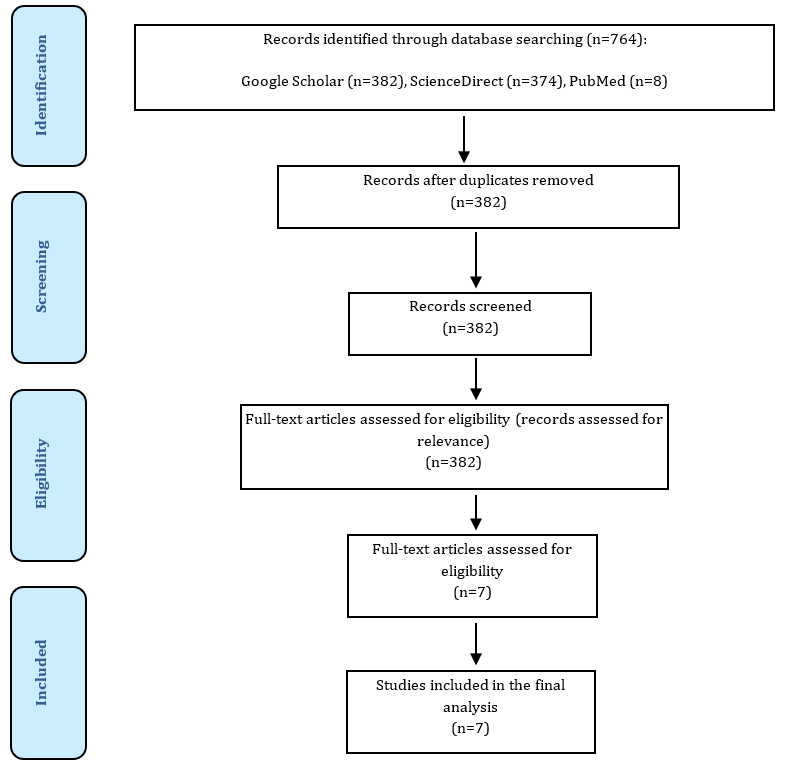
Figure 1. Search strategy and study selection process across databases.
Thematic categories identified from the included studies
The synthesis of the included studies identified two major categories regarding the application of civilian rescue robots in disaster response.
1. Rescue robot applications in disaster environments
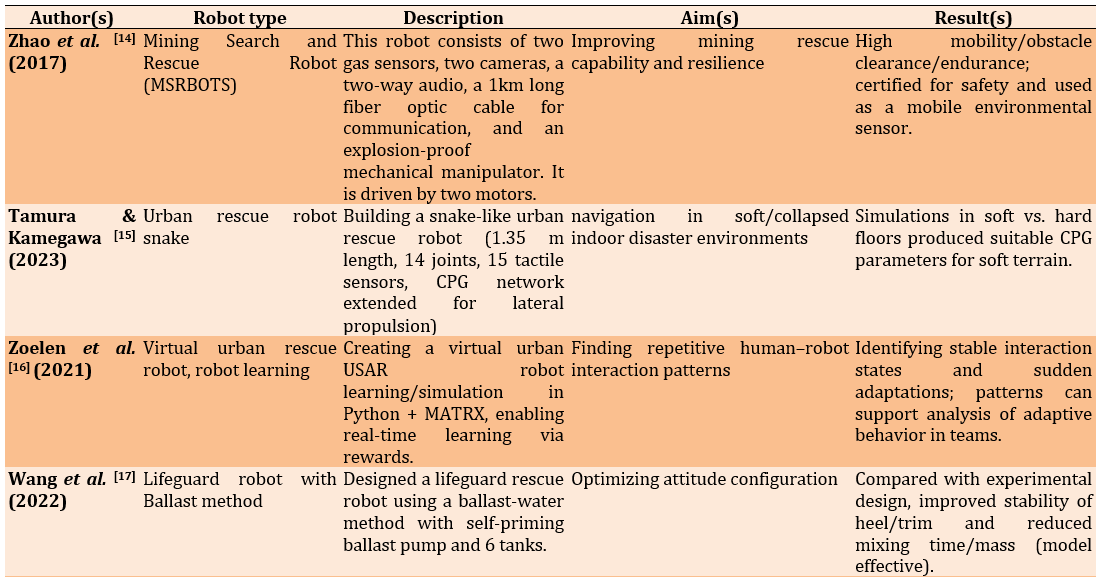
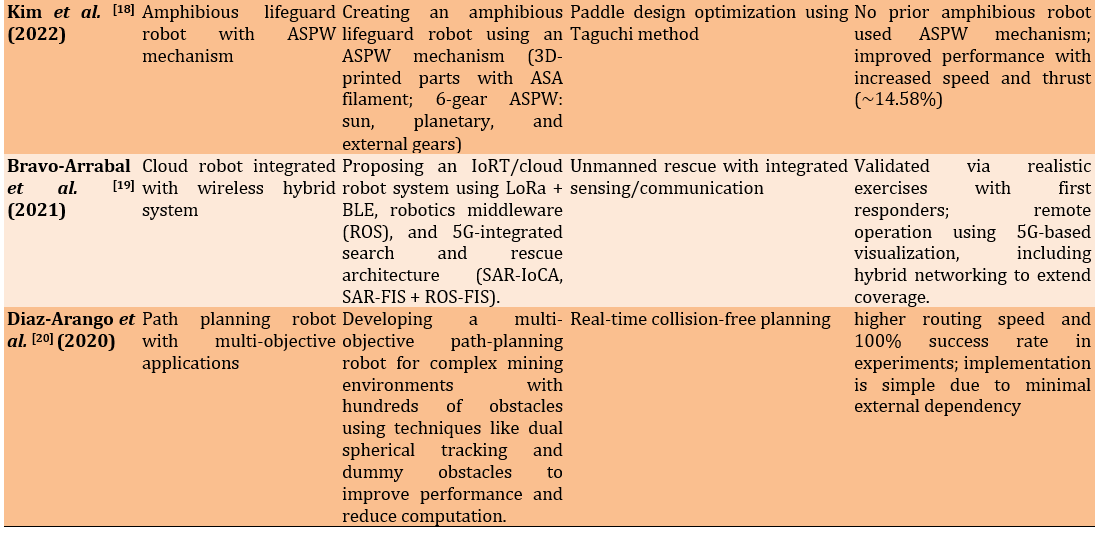
The reviewed studies demonstrated that civilian rescue robots have been developed to address the operational challenges of diverse disaster environments, with each robotic platform being specifically designed according to the characteristics of the target scenario. Mining rescue robots were developed to support rescue teams in hazardous underground environments through gas detection, environmental monitoring, and real-time communication [14]. Urban search and rescue robots focused on navigation through confined or collapsed structures and on improving collaboration between robots and human responders [15, 16]. Aquatic and amphibious rescue robots were designed to enhance rescue operations in water environments by improving stability, propulsion efficiency, and maneuverability [17, 18]. In addition, cloud-based robotic systems enabled communication, information exchange, and coordinated operations among robotic platforms and rescue personnel in complex disaster environments [19]. Collectively, these studies indicate that rescue robots are increasingly being tailored to the specific operational requirements of different disaster scenarios rather than relying on a single generalized robotic platform.
2. Operational outcomes and performance improvements
Despite differences in robot design and application domains, the included studies reported several common operational outcomes. Improvements in mobility, obstacle negotiation, and environmental adaptability were consistently observed in ground-based rescue robots [14, 15].
Studies evaluating navigation algorithms demonstrated higher path-planning efficiency, reduced computational complexity, and high mission success rates in complex environments [20]. Communication-oriented robotic systems enhanced information sharing and coordination between robots and rescue teams through wireless communication networks and cloud robotics architectures [16, 19]. Furthermore, aquatic rescue robots achieved improved stability, propulsion efficiency, and maneuverability, contributing to safer and more effective rescue operations in water-based emergencies [17, 18]. Overall, the findings suggest that recent developments in sensing technologies, autonomous navigation, communication systems, and human–robot collaboration have enhanced the operational effectiveness of civilian rescue robots across a variety of disaster settings.
Table 1. Basic characteristics of the selected studies
Discussion
This scoping review aimed to map the use of civilian rescue robots in disaster and emergency response scenarios and identify key technological domains. In recent years, the increasing frequency of floods and natural and human-induced disasters worldwide has resulted in substantial human casualties and significant economic losses, affecting both governmental systems and civilian populations. These events have also highlighted a critical shortage of specialized rescue equipment and advanced operational tools capable of ensuring timely and effective emergency response [21, 22]. Most existing rescue technologies—whether conventional or intelligent systems—are primarily designed for surface-based and passive rescue operations, with limited capability for active intervention, particularly in scenarios involving drowning or submersion [23, 24].
This gap underscores the urgent need for the development of next-generation rescue technologies that prioritize operational safety, rapid deployment, and adaptability across diverse disaster contexts. From a public health perspective, improving response time and access to victims may play a critical role in reducing mortality and morbidity in disaster and emergency settings [25]. Rescue robots were identified as among the most advanced and emerging technologies in the field of disaster response. The included studies demonstrated a wide range of applications of civilian rescue robots across different operational environments, reflecting the heterogeneity and evolving nature of this field. This diversity in design, functionality, and application domains further supports the need for an evidence mapping approach rather than a traditional systematic synthesis [26].
Some robots have attracted considerable attention in both academia and industry due to their advantageous features, including small size, a lightweight structure, lower cost, and high maneuverability compared to larger robotic systems. Such characteristics enable their application in confined and hard-to-reach environments, making them particularly suitable for search and rescue operations, structural inspection, and victim detection. In addition, their potential use in highly constrained environments may be particularly valuable in complex disaster scenarios, such as collapsed buildings or conflict-related incidents [5].
The lifeguard robot uses a ballast water system to adjust its spatial orientation in aquatic environments, thereby improving stability and adaptability during rescue operations. This feature enhances the robot’s ability to assist drowning victims and contributes to safer and more efficient rescue procedures. In contrast, an amphibious rescue robot uses an angled spoke paddling wheel (ASPW) mechanism to enhance propulsion in water. These advancements may translate into faster response times and improved rescue efficiency in aquatic emergencies, which are critical factors in preventing drowning-related fatalities [27].
Three included studies investigated the application of rescue robots in mining and underground environments [26]. These environments are among the most hazardous disaster settings due to confined spaces, toxic gases, and limited accessibility, which significantly restrict human intervention.
Similarly, a virtual rescue robot based on an optimized search algorithm improves environmental modeling accuracy and reduces unnecessary exploratory actions, resulting in shorter convergence times and more efficient path planning. These findings highlight the importance of intelligent navigation systems in enhancing the operational performance of rescue robots in complex environments. From a practical perspective, these improvements may contribute to faster victim localization and reduced response time in emergency situations [27].
A cloud-based rescue robotic system integrates a robotic Internet of Things (IoT) architecture with a feedback information system. The model enables real-time communication and coordination between robotic platforms and human responders through advanced networking technologies, including fog and edge computing. Notably, the system is evaluated in a real rescue scenario, demonstrating the feasibility of human-robot collaboration in complex emergency environments. These findings emphasize the critical role of communication infrastructure and interoperability in improving rescue outcomes, particularly in large-scale disasters and conflict-related incidents where coordinated response is essential [28].
Human-robot interaction is another key domain identified in this review. Adaptive interaction patterns between humans and robots in a simulated urban search-and-rescue environment suggest that structured interaction patterns can serve as a framework for analyzing and optimizing collaborative behavior between human responders and robotic systems. Effective human-robot interaction is particularly important in high-stress situations, such as disaster and war-related emergencies, where decision-making must be rapid, intuitive, and reliable [29, 30].
Despite growing interest and technological advancements in rescue robotics, their practical application in real-world scenarios remains limited. One of the primary challenges, particularly in environments, such as underground mines and collapsed structures, is the unstructured and dynamically changing nature of these settings, which requires a high degree of flexibility and adaptability in robotic systems. Furthermore, many existing rescue robots are relatively bulky and heavy, which can hinder rapid deployment in emergency situations. Communication constraints also represent a major limitation; several robotic systems rely on tethered connections to base stations, which, although providing stable data transmission and power supply, significantly restrict operational range—especially in environments, such as underwater or large-scale disaster zones where cables are impractical [1].
Wireless communication systems also face significant challenges, including signal attenuation, interference, and potential loss of connectivity in complex environments, such as subterranean spaces or collapsed infrastructure. In addition, energy limitations—particularly the restricted capacity and operational duration of onboard batteries—reduce the effectiveness of rescue robots in prolonged missions [1]. From a disaster management perspective, these limitations may delay rescue operations and reduce the potential impact of robotic systems on improving survival outcomes.
Another important limitation identified in this scoping review is the lack of standardized evaluation frameworks and real-world validation studies. Most included studies relied on simulations or controlled experimental settings, which limits the generalizability of findings to actual disaster or conflict scenarios.
Several directions for future research can be proposed. First, rescue robots should be systematically categorized based on their operational environments (e.g., aquatic, terrestrial, aerial, and confined spaces) to enable more meaningful comparisons and performance benchmarking across studies. Such categorization would facilitate more structured evidence synthesis in future research. Second, given the complexity and unpredictability of disaster- and war-related environments, future developments should prioritize the design of multipurpose and modular robotic systems capable of operating across diverse conditions, including land, water, and transitional environments.
In addition, future studies should consider the following priorities: integration of advanced sensing technologies (e.g., thermal imaging, gas detection, and LiDAR) to improve situational awareness and victim detection in low-visibility and hazardous conditions; incorporation of artificial intelligence and autonomous decision-making systems to enhance navigation, adaptability, and real-time response in dynamic environments; evaluation of user interface design to ensure effective human-robot interaction, particularly for non-expert operators under stressful conditions; increased emphasis on real-world testing and field validation, rather than reliance on simulation-based studies; and improvement of energy efficiency and power management systems to enable longer operational duration in remote or inaccessible areas. From a public health perspective, future research should also evaluate the impact of rescue robots on clinical and operational outcomes, such as response time, injury severity, and survival rates in disaster and conflict settings.
Conclusion
Rescue robots have high potential for improving emergency response and public health outcomes in disaster and conflict settings.
Acknowledgments: The author has no acknowledgments.
Ethical Permissions: This study is a scoping review based exclusively on published literature and did not involve human participants, animals, or identifiable personal data. Therefore, ethics committee approval was not required.
Conflicts of Interests: The author declared no conflicts of interest.
Authors' Contribution: Jiryaei Z (First Author), Introduction Writer/Methodologist/Main Researcher/Discussion Writer/Statistical Analyst (100%)
Funding/Support: This research received no specific grant from any funding agency in the public, commercial, or not-for-profit sectors.
In disaster environments—such as underground mines, collapsed structures, fire-affected zones, and conflict-related settings—the presence of rescuers is significantly limited due to the accumulation of toxic gases, structural instability, and poor visibility. These environments often contain harmful gases, such as carbon dioxide, carbon monoxide, methane, and other explosive compounds, which obstruct rescuers’ vision and hinder effective rescue operations [1]. Such constraints highlight the critical importance of the initial hours following a disaster, during which timely intervention can determine survival outcomes for trapped individuals [2].
In response to these challenges, the use of rescue robots has emerged as a promising solution, supported by substantial advancements in robotics, sensor technologies, and communication systems. These systems enable emergency responders to operate remotely in high-risk environments, performing essential tasks, such as navigation, environmental monitoring, victim detection, and situational assessment [3]. From a healthcare perspective, these capabilities may contribute to earlier identification of victims, reduce responders’ exposure to hazardous conditions, and improve the efficiency of rescue operations.
Importantly, in armed conflicts and war-related emergencies—where infrastructure damage, explosions, and unsafe environments can severely limit human access to affected areas—rescue robots may play a critical role in facilitating rapid and safe response. Their deployment can support timely access to victims, reduce delays in rescue operations, and ultimately contribute to improved survival outcomes and reduced burden on emergency medical systems [4, 5].
Despite rapid technological progress, the current body of literature on rescue robots lacks standardized evaluation metrics and comparable performance indicators. Although several studies have validated their systems through simulations or controlled field experiments, large-scale real-world evaluations in diverse disaster settings remain limited, restricting the generalizability and comparability of reported findings [6-8].
This variability creates significant challenges for synthesizing evidence regarding the effectiveness of rescue robots, particularly in relation to operational outcomes and potential impacts on human safety and emergency care. Furthermore, the lack of consistent outcome measures and methodological uniformity limits the feasibility of conducting a traditional systematic review, which typically requires well-defined research questions, homogeneous study designs, and comparable outcome metrics. Given the exploratory and multidisciplinary nature of rescue robotics—spanning engineering, emergency response, and public health—these conditions are not adequately met [9, 10].
For this reason, a scoping review approach was considered more appropriate for mapping the current landscape of rescue robotics in disaster and emergency contexts. Scoping reviews are particularly suited to heterogeneous and evolving fields, as they systematically map the available evidence, identify key concepts, categorize research domains, and highlight existing knowledge gaps [11, 12]. The PRISMA-ScR guidelines [13] were followed to ensure a transparent and methodologically rigorous approach to data collection and reporting.
The primary aim of this scoping review was to map the use of civilian rescue robots in disaster and emergency response scenarios, identify key technological domains, and categorize existing research based on application and functionality. By providing a structured synthesis of the available evidence, this study sought to identify critical gaps in the field and support future research directions, particularly in relation to improving safety, operational efficiency, and potential applications in disaster medicine and conflict-related emergencies.
Information and Methods
This scoping review was limited to articles published in English between January 2017 and September 2024 (the last seven years). The search strategy was developed using the population, intervention, comparison, and outcome (PICO) framework. A systematic search was conducted across several scientific databases, including PubMed, ISI Web of Knowledge, Scopus, ScienceDirect, and Google Scholar. The search terms were combined using Boolean operators (AND, OR) and limited to studies published between 2014 and 2024.
The inclusion criteria were studies that examined the role of robots specifically in rescue operations, studies that described the characteristics of rescue robots, including their technical or functional attributes related to disaster response, and studies that investigated the use of robots in human-made and natural disasters, including both urban and rural environments. Exclusion criteria were studies that did not investigate the role of robots in rescue operations, studies that utilized other types of emergency technologies, such as UAVs, sensors, or traditional methods, without focusing on robots, and studies where the robots were designed for military or warfare purposes.
The selection of studies was based on screening titles, abstracts, methodology, and type of intervention. Studies with low relevance to the research objective or those that did not provide meaningful information for mapping rescue robotics were excluded to ensure methodological focus and coherence.
Two independent reviewers screened the titles and abstracts of all records identified through the initial search to determine eligibility for full-text review. Full-text screening was then conducted for potentially relevant studies. Any disagreements between the two reviewers were resolved through discussion, and when necessary, a third reviewer was consulted to reach consensus.
Data extraction was performed independently by the same two reviewers using a standardized extraction form. Extracted data included study characteristics, robot type, application domain, technological features, and key findings. Consistency between reviewers was assessed, and discrepancies were resolved through consensus with a third reviewer.
Findings
The search strategy initially yielded 764 records. After title screening, abstract review, and full-text assessment based on the predefined inclusion criteria, seven studies were ultimately included in the final analysis (Figure 1).
Figure 1. Search strategy and study selection process across databases.
Thematic categories identified from the included studies
The synthesis of the included studies identified two major categories regarding the application of civilian rescue robots in disaster response.
1. Rescue robot applications in disaster environments
The reviewed studies demonstrated that civilian rescue robots have been developed to address the operational challenges of diverse disaster environments, with each robotic platform being specifically designed according to the characteristics of the target scenario. Mining rescue robots were developed to support rescue teams in hazardous underground environments through gas detection, environmental monitoring, and real-time communication [14]. Urban search and rescue robots focused on navigation through confined or collapsed structures and on improving collaboration between robots and human responders [15, 16]. Aquatic and amphibious rescue robots were designed to enhance rescue operations in water environments by improving stability, propulsion efficiency, and maneuverability [17, 18]. In addition, cloud-based robotic systems enabled communication, information exchange, and coordinated operations among robotic platforms and rescue personnel in complex disaster environments [19]. Collectively, these studies indicate that rescue robots are increasingly being tailored to the specific operational requirements of different disaster scenarios rather than relying on a single generalized robotic platform.
2. Operational outcomes and performance improvements
Despite differences in robot design and application domains, the included studies reported several common operational outcomes. Improvements in mobility, obstacle negotiation, and environmental adaptability were consistently observed in ground-based rescue robots [14, 15].
Studies evaluating navigation algorithms demonstrated higher path-planning efficiency, reduced computational complexity, and high mission success rates in complex environments [20]. Communication-oriented robotic systems enhanced information sharing and coordination between robots and rescue teams through wireless communication networks and cloud robotics architectures [16, 19]. Furthermore, aquatic rescue robots achieved improved stability, propulsion efficiency, and maneuverability, contributing to safer and more effective rescue operations in water-based emergencies [17, 18]. Overall, the findings suggest that recent developments in sensing technologies, autonomous navigation, communication systems, and human–robot collaboration have enhanced the operational effectiveness of civilian rescue robots across a variety of disaster settings.
Table 1. Basic characteristics of the selected studies
Discussion
This scoping review aimed to map the use of civilian rescue robots in disaster and emergency response scenarios and identify key technological domains. In recent years, the increasing frequency of floods and natural and human-induced disasters worldwide has resulted in substantial human casualties and significant economic losses, affecting both governmental systems and civilian populations. These events have also highlighted a critical shortage of specialized rescue equipment and advanced operational tools capable of ensuring timely and effective emergency response [21, 22]. Most existing rescue technologies—whether conventional or intelligent systems—are primarily designed for surface-based and passive rescue operations, with limited capability for active intervention, particularly in scenarios involving drowning or submersion [23, 24].
This gap underscores the urgent need for the development of next-generation rescue technologies that prioritize operational safety, rapid deployment, and adaptability across diverse disaster contexts. From a public health perspective, improving response time and access to victims may play a critical role in reducing mortality and morbidity in disaster and emergency settings [25]. Rescue robots were identified as among the most advanced and emerging technologies in the field of disaster response. The included studies demonstrated a wide range of applications of civilian rescue robots across different operational environments, reflecting the heterogeneity and evolving nature of this field. This diversity in design, functionality, and application domains further supports the need for an evidence mapping approach rather than a traditional systematic synthesis [26].
Some robots have attracted considerable attention in both academia and industry due to their advantageous features, including small size, a lightweight structure, lower cost, and high maneuverability compared to larger robotic systems. Such characteristics enable their application in confined and hard-to-reach environments, making them particularly suitable for search and rescue operations, structural inspection, and victim detection. In addition, their potential use in highly constrained environments may be particularly valuable in complex disaster scenarios, such as collapsed buildings or conflict-related incidents [5].
The lifeguard robot uses a ballast water system to adjust its spatial orientation in aquatic environments, thereby improving stability and adaptability during rescue operations. This feature enhances the robot’s ability to assist drowning victims and contributes to safer and more efficient rescue procedures. In contrast, an amphibious rescue robot uses an angled spoke paddling wheel (ASPW) mechanism to enhance propulsion in water. These advancements may translate into faster response times and improved rescue efficiency in aquatic emergencies, which are critical factors in preventing drowning-related fatalities [27].
Three included studies investigated the application of rescue robots in mining and underground environments [26]. These environments are among the most hazardous disaster settings due to confined spaces, toxic gases, and limited accessibility, which significantly restrict human intervention.
Similarly, a virtual rescue robot based on an optimized search algorithm improves environmental modeling accuracy and reduces unnecessary exploratory actions, resulting in shorter convergence times and more efficient path planning. These findings highlight the importance of intelligent navigation systems in enhancing the operational performance of rescue robots in complex environments. From a practical perspective, these improvements may contribute to faster victim localization and reduced response time in emergency situations [27].
A cloud-based rescue robotic system integrates a robotic Internet of Things (IoT) architecture with a feedback information system. The model enables real-time communication and coordination between robotic platforms and human responders through advanced networking technologies, including fog and edge computing. Notably, the system is evaluated in a real rescue scenario, demonstrating the feasibility of human-robot collaboration in complex emergency environments. These findings emphasize the critical role of communication infrastructure and interoperability in improving rescue outcomes, particularly in large-scale disasters and conflict-related incidents where coordinated response is essential [28].
Human-robot interaction is another key domain identified in this review. Adaptive interaction patterns between humans and robots in a simulated urban search-and-rescue environment suggest that structured interaction patterns can serve as a framework for analyzing and optimizing collaborative behavior between human responders and robotic systems. Effective human-robot interaction is particularly important in high-stress situations, such as disaster and war-related emergencies, where decision-making must be rapid, intuitive, and reliable [29, 30].
Despite growing interest and technological advancements in rescue robotics, their practical application in real-world scenarios remains limited. One of the primary challenges, particularly in environments, such as underground mines and collapsed structures, is the unstructured and dynamically changing nature of these settings, which requires a high degree of flexibility and adaptability in robotic systems. Furthermore, many existing rescue robots are relatively bulky and heavy, which can hinder rapid deployment in emergency situations. Communication constraints also represent a major limitation; several robotic systems rely on tethered connections to base stations, which, although providing stable data transmission and power supply, significantly restrict operational range—especially in environments, such as underwater or large-scale disaster zones where cables are impractical [1].
Wireless communication systems also face significant challenges, including signal attenuation, interference, and potential loss of connectivity in complex environments, such as subterranean spaces or collapsed infrastructure. In addition, energy limitations—particularly the restricted capacity and operational duration of onboard batteries—reduce the effectiveness of rescue robots in prolonged missions [1]. From a disaster management perspective, these limitations may delay rescue operations and reduce the potential impact of robotic systems on improving survival outcomes.
Another important limitation identified in this scoping review is the lack of standardized evaluation frameworks and real-world validation studies. Most included studies relied on simulations or controlled experimental settings, which limits the generalizability of findings to actual disaster or conflict scenarios.
Several directions for future research can be proposed. First, rescue robots should be systematically categorized based on their operational environments (e.g., aquatic, terrestrial, aerial, and confined spaces) to enable more meaningful comparisons and performance benchmarking across studies. Such categorization would facilitate more structured evidence synthesis in future research. Second, given the complexity and unpredictability of disaster- and war-related environments, future developments should prioritize the design of multipurpose and modular robotic systems capable of operating across diverse conditions, including land, water, and transitional environments.
In addition, future studies should consider the following priorities: integration of advanced sensing technologies (e.g., thermal imaging, gas detection, and LiDAR) to improve situational awareness and victim detection in low-visibility and hazardous conditions; incorporation of artificial intelligence and autonomous decision-making systems to enhance navigation, adaptability, and real-time response in dynamic environments; evaluation of user interface design to ensure effective human-robot interaction, particularly for non-expert operators under stressful conditions; increased emphasis on real-world testing and field validation, rather than reliance on simulation-based studies; and improvement of energy efficiency and power management systems to enable longer operational duration in remote or inaccessible areas. From a public health perspective, future research should also evaluate the impact of rescue robots on clinical and operational outcomes, such as response time, injury severity, and survival rates in disaster and conflict settings.
Conclusion
Rescue robots have high potential for improving emergency response and public health outcomes in disaster and conflict settings.
Acknowledgments: The author has no acknowledgments.
Ethical Permissions: This study is a scoping review based exclusively on published literature and did not involve human participants, animals, or identifiable personal data. Therefore, ethics committee approval was not required.
Conflicts of Interests: The author declared no conflicts of interest.
Authors' Contribution: Jiryaei Z (First Author), Introduction Writer/Methodologist/Main Researcher/Discussion Writer/Statistical Analyst (100%)
Funding/Support: This research received no specific grant from any funding agency in the public, commercial, or not-for-profit sectors.
Keywords:
References
1. Reddy AH, Kalyan B, Murthy CS. Mine rescue robot system-a review. Procedia Earth Planet Sci. 2015;11:457-62. [Link] [DOI:10.1016/j.proeps.2015.06.045]
2. Fan H, Hernandez Bennetts V, Schaffernicht E, Lilienthal AJ. Towards gas discrimination and mapping in emergency response scenarios using a mobile robot with an electronic nose. Sensors. 2019;19(3):685. [Link] [DOI:10.3390/s19030685]
3. Li J, Deng J, Zhang S, Chen W, Zhao J, Liu Y. Developments and challenges of miniature piezoelectric robots: A review. Adv Sci. 2023;10(36):2305128. [Link] [DOI:10.1002/advs.202305128]
4. Murphy RR. Disaster robotics. Cambridge: MIT Press; 2017. [Link] [DOI:10.1007/978-3-319-32552-1_60]
5. Kruijff GJM, Colas F, Svoboda T, Van Diggelen J, Balmer P, Pirri F, et al. Designing intelligent robots for human-robot teaming in urban search and rescue. Washington, DC: AAAI Spring Symposium; 2012. [Link] [DOI:10.1007/978-3-642-40686-7_8]
6. Murphy, RR. Disaster robotics. 2017. Cambridge: MIT Press. [Link] [DOI:10.1007/978-3-319-32552-1_60]
7. Casper J, Murphy RR. Human-robot interactions during the robot-assisted urban search and rescue response at the world trade center. IEEE Transactions on Systems, Man, and Cybernetics, Part B (Cybernetics). 2003 Jun 30;33(3):367-85. [Link] [DOI:10.1109/TSMCB.2003.811794]
8. Siciliano, B., & Khatib, O. (Eds.). Springer handbook of robotics (2nd ed.). 2016. Switzerland: Springer. [Link] [DOI:10.1007/978-3-319-32552-1]
9. Peters MDJ, Godfrey C, McInerney P, Munn Z, Tricco AC, Khalil, H. Chapter 11: Scoping Reviews (2020 version). In: Aromataris E, Munn Z (Editors). BI Manual for Evidence Synthesi, JBI. 2020. [Link] [DOI:10.46658/JBIRM-20-01]
10. Munn Z, Peters MD, Stern C, Tufanaru C, McArthur A, Aromataris E. Systematic review or scoping review? Guidance for authors when choosing between a systematic or scoping review approach. BMC medical research methodology. 2018;18(1):143. [Link] [DOI:10.1186/s12874-018-0611-x]
11. Arksey H, O'malley L. Scoping studies: towards a methodological framework. Int J Soc Res Method. 2005;8(1):19-32. [Link] [DOI:10.1080/1364557032000119616]
12. Pham MT, Rajić A, Greig JD, Sargeant JM, Papadopoulos A, McEwen SA. A scoping review of scoping reviews: advancing the approach and enhancing the consistency. Res Synth Methods. 2014;5(4):371-85. [Link] [DOI:10.1002/jrsm.1123]
13. Tricco AC, Lillie E, Zarin W, O'Brien KK, Colquhoun H, Levac D, et al. PRISMA extension for scoping reviews (PRISMA-ScR): Checklist and explanation. Ann Intern Med. 2018;169(7):467-73. [Link] [DOI:10.7326/M18-0850]
14. Zhao J, Gao J, Zhao F, Liu Y. A search-and-rescue robot system for remotely sensing the underground coal mine environment. Sensors. 2017;17(10):2426. [Link] [DOI:10.3390/s17102426]
15. Tamura H, Kamegawa T. Parameter search of a CPG network using a genetic algorithm for a snake robot with tactile sensors moving on a soft floor. Front Robot AI. 2023;10:1138019. [Link] [DOI:10.3389/frobt.2023.1138019]
16. Zoelen EMV, Van Den Bosch K, Neerincx M. Becoming team members: Identifying interaction patterns of mutual adaptation for human-robot co-learning. Front Robot AI. 2021;8:692811. [Link] [DOI:10.3389/frobt.2021.692811]
17. Wang S, Pan D, Zhou Z, Yu H, Ma X, Fang G. Optimization method and experimental research on attitude adjustment scheme of attitude adaptive rescue robot. Sci Rep. 2022;12(1):18010. [Link] [DOI:10.1038/s41598-022-22991-7]
18. Kim C, Han S, Won J, Seo T. Empirical optimization of an angled spoke paddling wheel with self-rotating mechanism. Sci Rep. 2022;12(1):20511. [Link] [DOI:10.1038/s41598-022-25181-7]
19. Bravo-Arrabal J, Toscano-Moreno M, Fernández-Lozano JJ, Mandow A, Gomez-Ruiz JA, García-Cerezo A. The Internet of Cooperative Agents Architecture (X-IoCA) for robots, hybrid sensor networks, and MEC centers in complex environments: A search and rescue case study. Sensors. 2021;21(23):7843. [Link] [DOI:10.3390/s21237843]
20. Diaz-Arango G, Vazquez-Leal H, Hernandez-Martinez L, Jimenez-Fernandez VM, Heredia-Jimenez A, Ambrosio RC, et al. Multiple-target homotopic quasi-complete path planning method for mobile robot using a piecewise linear approach. Sensors. 2020;20(11):3265. [Link] [DOI:10.3390/s20113265]
21. Ray-Bennett NS. What is a Disaster?. InAvoiding Disaster Deaths: Why Do So Many People Die? 2025. Cham: Springer Nature Switzerland. 1-19. [Link] [DOI:10.1007/978-3-031-81300-9_1]
22. Kuday AD, Özcan T, Çalışkan C, Kınık K. Challenges faced by medical rescue teams during disaster response: a systematic review study. Disaster Med Public Health Prep. 2023;17:e548. [Link] [DOI:10.1017/dmp.2023.217]
23. Thaker RK. Robotics in disaster management: AI-driven rescue, aerial mapping, and emerging IoT applications for effective response. Int J Innovat Res Eng Multidiscip Phys Sci. 2024;12(6). [Link] [DOI:10.37082/IJIRMPS.v12.i6.231435]
24. Rizk Y, Awad M, Tunstel EW. Cooperative heterogeneous multi-robot systems: A survey. ACM Comput Surv. 2019;52(2):1-31. [Link] [DOI:10.1145/3303848]
25. Alshebani MM, Alanazi MQ, Alanazi AE, Almotlaq MA, Almeshari AM, Alotib HE, et al. Response time in emergency services: A narrative review. TPM Test Psychom Methodol Appl Psychol. 2025;32(S9):2047-56. [Link]
26. Khalil H, Campbell F, Danial K, Pollock D, Munn Z, Welsh V, et al. Advancing the methodology of mapping reviews: A scoping review. Res Synth Methods. 2024;15(3):384-97. [Link] [DOI:10.1002/jrsm.1694]
27. Le Dé L. Bridging gaps between disaster risk reduction and drowning prevention. Int J Disaster Risk Reduct. 2024;106:104445. [Link] [DOI:10.1016/j.ijdrr.2024.104445]
28. Skarga-Bandurova I, Biloborodova T, Kjelstrup-Johnson KR, Olde Scheper TV, Derkach M. Securing tomorrow's cities: Smart infrastructure for emergency response, crisis management, and defence. In: Sustainable, innovative, and intelligent industries and societies. Cham: Springer; 2026. p. 69-111. [Link] [DOI:10.1007/978-3-032-11013-8_3]
29. Jafarpisheh AS, Jiryaei Z, Moulodi N. Upper limb wearable robots. Tehran: University of Social Welfare and Rehabilitation Sciences; 2023. [Persian] [Link]
30. Jarrassier A, De Rocquigny G, Delagarde C, Ezanno AC, Josse F, Dubost C, et al. Transposing intensive care innovation from modern warfare to other resource-limited settings. Eur J Trauma Emerg Surg. 2025;51(1):290. [Link] [DOI:10.1007/s00068-025-02974-9]