

JMERC
Owner
Janbazan Medical and Engineering Research Center (JMERC) is the owner of IJWPH.

1.0
Cite Score 2025
SJR: 0.129 / SNIP: 0.140
Volume 18, Issue 2 (2026)
Iran J War Public Health 2026, 18(2): 157-164 |
Back to browse issues page
Article Type:
Subject:




Ethics code: IR.IAU.SARI.REC.1405.049
History
Received: 2026/02/19 | Accepted: 2026/03/29 | Published: 2026/04/8
Received: 2026/02/19 | Accepted: 2026/03/29 | Published: 2026/04/8
How to cite this article
Safaei I, Ahmadi M, Soleymani Tapesari B, Shojaei V, Ozgoli A. Mindfulness and Body Awareness Reduces Anxiety and Improves Sleep in Male Veteran Athletes. Iran J War Public Health 2026; 18 (2) :157-164
URL: http://ijwph.ir/article-1-1764-en.html
URL: http://ijwph.ir/article-1-1764-en.html
Download citation:
BibTeX | RIS | EndNote | Medlars | ProCite | Reference Manager | RefWorks
Send citation to:


Rights and permissions
BibTeX | RIS | EndNote | Medlars | ProCite | Reference Manager | RefWorks
Send citation to:

1- Department of Physical Education and Sport Sciences, BG.C. (Bandargaz Campus), Islamic Azad University, Bandargaz, Iran
2- Department of Physical Education, Adib Mazandaran Institute of Higher Education, Mazandaran, Iran
3- Department of Sport Management, Sar.C. (Sari Campus), Islamic Azad University, Sari, Iran
2- Department of Physical Education, Adib Mazandaran Institute of Higher Education, Mazandaran, Iran
3- Department of Sport Management, Sar.C. (Sari Campus), Islamic Azad University, Sari, Iran
Full-Text (HTML) (22 Views)
Introduction
Veterans constitute a population at elevated risk for psychological difficulties and sleep disturbances. Exposure to combat-related trauma, physical disabilities, chronic pain, and psychosocial stressors may contribute to the development and persistence of anxiety symptoms and sleep-related problems in this population [1]. Anxiety and insomnia are among the most prevalent mental health concerns among veterans, and these conditions exhibit a bidirectional relationship. Increased anxiety may impair sleep quality, while sleep disturbances can exacerbate anxiety symptoms [2, 3]. This issue is particularly important among veteran athletes, as inadequate sleep and elevated anxiety may adversely affect physical recovery, concentration, psychological readiness, and athletic performance. High levels of anxiety are associated with increased physiological arousal, cognitive worry, and impaired attentional control, thereby negatively influencing athletic performance, physical recovery, and psychological well-being. Given the reciprocal relationship between anxiety and sleep, heightened anxiety may further compromise physical recovery, concentration, and psychological preparedness among veteran athletes. Moreover, anxiety may disrupt both sleep initiation and sleep maintenance through increased rumination and autonomic arousal [3]. Consequently, anxiety reduction has become a primary target of mental health interventions designed for veteran athletes.
In recent years, mindfulness- and body awareness-based interventions have received considerable attention as effective approaches for promoting psychological well-being and enhancing performance in both athletic and clinical populations. Mindfulness refers to the process of intentionally attending to present-moment experiences with an attitude of acceptance and nonjudgment, and it forms the core component of interventions, such as mindfulness-based stress reduction (MBSR) [4, 5]. Body awareness, in contrast, refers to the capacity to perceive and monitor internal bodily sensations, breathing patterns, and physiological changes, and it plays a critical role in emotion regulation and stress reduction [6]. The simultaneous enhancement of mental and bodily awareness may improve psychological adjustment, reduce anxiety, and promote better sleep quality [7]. Furthermore, a recent systematic review and meta-analysis reported that mindfulness-based interventions, embodiment practices, and cognitive strategies can produce significant reductions in state anxiety and represent some of the most effective short-term approaches for anxiety management [8].
Mindfulness interventions, which incorporate attentional training, body awareness exercises, and nonjudgmental acceptance of moment-to-moment experiences, have demonstrated effectiveness in sport settings by enhancing emotional regulation, improving attentional focus, and reducing performance- and competition-related anxiety [9].
From a neurobiological perspective, evidence indicates that mindfulness practices may regulate neural networks involved in attention, emotion processing, and self-regulation. Neuroimaging studies have reported reduced amygdala activation and increased engagement of prefrontal cortical regions following mindfulness training; these changes are associated with improved emotional control and reduced anxiety [10]. In addition, mindfulness may enhance sleep quality by modulating hypothalamic-pituitary-adrenal (HPA) axis activity and attenuating physiological stress responses [4]. Similarly, body awareness practices facilitate greater sensitivity to bodily signals and promote parasympathetic nervous system activation, thereby contributing to reduced physiological arousal, improved emotion regulation, and enhanced sleep quality [6].
Mindfulness and body awareness interventions, whether implemented independently or in combination, are effective in improving mental health outcomes, including anxiety, depression, and sleep quality [6, 7]. Research further indicates that integrated mind-body interventions can alleviate anxiety, stress, and sleep disturbances across athletic, military, and clinical populations [11, 12]. Studies involving veterans have similarly demonstrated that mind-body interventions can reduce stress, anxiety, and sleep-related symptoms while enhancing psychological adaptation and resilience [7, 13]. Mindfulness-based, body awareness-based, and related mind-body interventions are associated with improved mental health, reduced anxiety, and enhanced sleep quality across diverse populations [6]. Nevertheless, empirical evidence regarding the effectiveness of integrated mindfulness and body awareness programs among veteran athletes, particularly within non-Western cultural contexts, remains limited.
Despite promising findings concerning the effectiveness of mindfulness- and body awareness-based interventions, several important research gaps remain. First, most previous studies have focused on general populations, healthy athletes, or non-athlete veterans, whereas intervention studies specifically targeting veteran athletes remain scarce [14].
Second, most available evidence has been generated in Western countries, and little is known about the effectiveness of these interventions in different cultural settings, including the Iranian veteran population [15]. Furthermore, evidence concerning integrated mindfulness and body awareness interventions among athletes with disabilities, particularly within Middle Eastern societies, is limited. Additionally, most previous studies have
examined mindfulness and body awareness separately, with relatively few investigations assessing the effects of integrated mind-body programs on both anxiety and sleep quality simultaneously. Therefore, despite growing evidence supporting the benefits of mindfulness and body awareness interventions for psychological outcomes, research examining the effectiveness of integrated mindfulness and body awareness programs among veteran athletes remains limited. Moreover, existing evidence is predominantly derived from Western populations, which restricts the generalizability of findings to other cultural contexts [9, 15].
Given the high prevalence of anxiety and sleep disturbances among veteran athletes, the importance of mental health for maintaining athletic performance and quality of life, and the limited empirical evidence regarding the effectiveness of integrated mindfulness and body awareness interventions in this population, further investigation is warranted. Accordingly, this study aimed to examine the effectiveness of an eight-week mindfulness and body awareness program in reducing anxiety and improving sleep quality among male veteran athletes. Specifically, the study sought to determine whether participation in this program would lead to significant reductions in anxiety and improvements in sleep quality within this population.
Materials and Methods
Design and participants
This quasi-experimental study employed a pretest–post-test design with a control group and was conducted among male veteran athletes from Mazandaran Province, Iran, in 2026.
The sample consisted of all male veteran athletes residing in Mazandaran Province who were actively participating in sports programs organized by the Veterans and Disabled Sports Federations during 2026. According to records from the Foundation of Martyrs and Veterans Affairs, approximately 450 veteran athletes were registered in these organizations during the study period.
Participants were selected using purposive convenience sampling. Participants were then randomly assigned through a simple lottery procedure to either the experimental group (n=30) or the control group (n=30). Random allocation was used to minimize selection bias and enhance baseline equivalence between the groups. Consequently, the two groups were comparable with respect to demographic characteristics and baseline study parameters.
The inclusion criteria were possession of a valid veteran identification card issued by the Foundation of Martyrs and Veterans Affairs, a minimum of two years of regular sports participation, age between 30 and 55 years, residence in Mazandaran Province, absence of severe psychiatric disorders according to medical records, and willingness to participate voluntarily in the training sessions.
The exclusion criteria were absence from more than two intervention sessions, use of sedative or hypnotic medications during the intervention period, development of a new physical or psychological disorder during the study, and failure to complete the study questionnaires.
Procedure
The study was conducted in accordance with ethical principles for human research and was approved by the institutional ethics committee. Before participation, all individuals provided written informed consent and were assured of confidentiality.
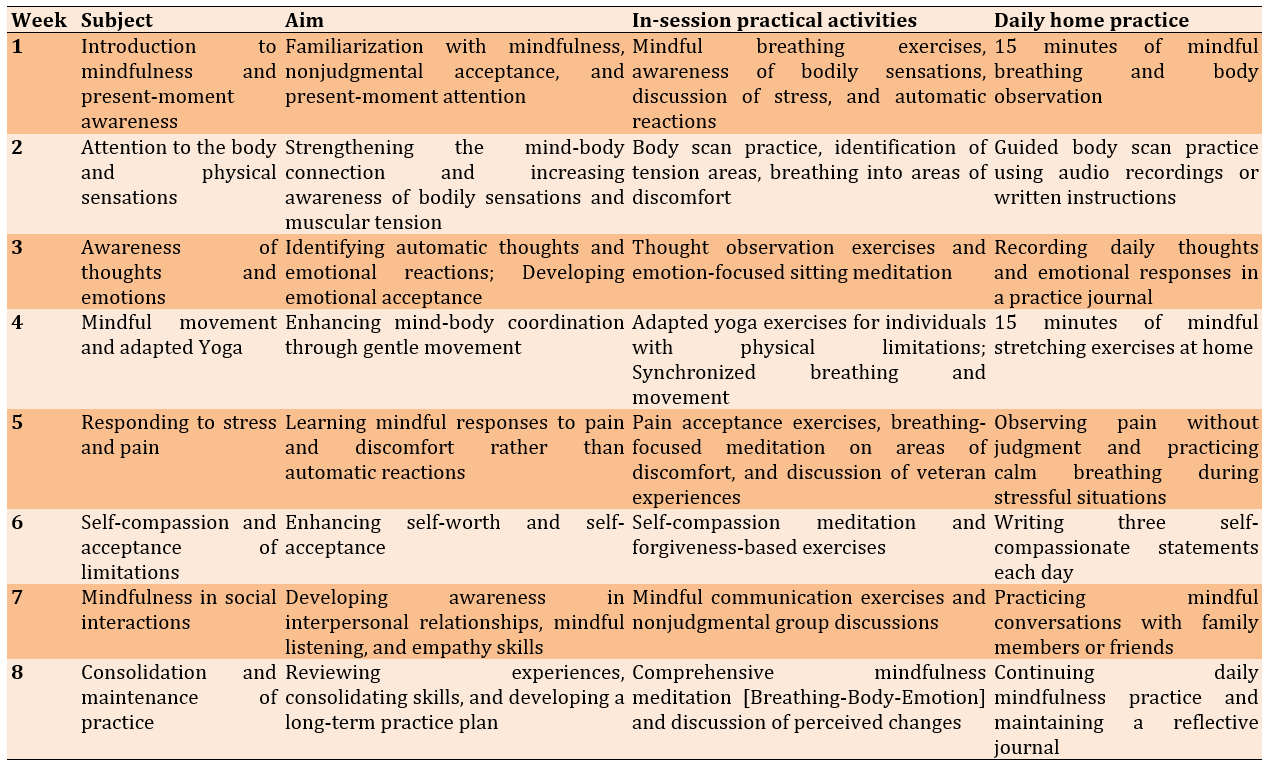
The intervention consisted of an eight-week mindfulness and body awareness training program for the experimental group. Sessions were delivered twice weekly, each lasting 90 minutes, in a multipurpose sports facility affiliated with the Mazandaran Department of Youth and Sports. Each session included 30 minutes of psychoeducation, 45 minutes of guided practice, and 15 minutes of group discussion, and was facilitated by a certified sports psychologist. The program was based on the mindfulness and body awareness approach associated with MBSR principles (Kabat-Zinn and Hanh [5]) and included mindful breathing, body scans, seated meditation, attention to bodily sensations, yoga-based movements, and nonjudgmental acceptance of thoughts and emotions. Participants received guided meditation audio recordings, a daily practice workbook, and weekly self-monitoring forms, and were instructed to complete at least 20 minutes of home practice daily.
Adherence and completion were assessed weekly through submission of practice journals documenting assigned exercises and emotional changes. To monitor intervention quality, brief semi-structured interviews were conducted during weeks 4 and 8 to evaluate attentional focus and emotional acceptance. The control group received no intervention and attended only the assessment sessions.
At baseline (pre-test), all participants completed the State-Trait Anxiety Inventory (STAI) and the Pittsburgh Sleep Quality Index (PSQI). The same measures were administered again after the intervention (post-test).
Instrument
State-Trait Anxiety Inventory (STAI)
Anxiety was assessed using the State-Trait Anxiety Inventory (STAI), developed by Spielberger & Gorsuch [16]. The instrument consists of 40 items divided into two 20-item subscales measuring state anxiety and trait anxiety, respectively. State anxiety reflects transient emotional reactions experienced at a particular moment, whereas trait anxiety assesses a relatively stable tendency to perceive situations as threatening. Items are rated on a four-point Likert scale, with higher scores indicating greater levels of anxiety.
Previous research has demonstrated satisfactory psychometric properties of the STAI, with Cronbach’s alpha coefficients generally exceeding 0.85 for both subscales [16]. In addition, evidence supporting its construct validity and convergent validity has been reported across numerous studies, showing significant correlations with other measures of anxiety [17]. In Iran, Dehshiri et al. reported Cronbach’s alpha coefficients of approximately 0.90 for both subscales and confirmed the instrument’s two-factor structure [18].
Table 1. Eight-week mindfulness and body awareness training program for veteran athletes
Pittsburgh Sleep Quality Index (PSQI)
Buysse et al. developed the Pittsburgh Sleep Quality Index (PSQI), which was used to assess sleep quality [19]. The PSQI evaluates sleep quality over the preceding month and consists of 19 self-report items grouped into seven components, including subjective sleep quality, sleep latency, sleep duration, habitual sleep efficiency, sleep disturbances, use of sleep medication, and daytime dysfunction. Each component is scored on a scale ranging from 0 to 3, yielding a global score between 0 and 21. Higher scores indicate poorer sleep quality.
The PSQI is among the most widely used measures of sleep quality in both clinical and sports-related research and has demonstrated satisfactory psychometric properties across diverse populations. The original validation study reported acceptable internal consistency (Cronbach’s α=0.83), as well as satisfactory convergent validity with both subjective and objective indicators of sleep quality.
The Persian version of the PSQI has also demonstrated favorable psychometric characteristics. Farrahi Moghaddam et al. reported Cronbach’s alpha coefficients ranging from 0.80 to 0.86 and confirmed its construct validity and ability to discriminate between individuals with good and poor sleep quality [20].
Mindful Attention Awareness Scale (MAAS)
Although anxiety and sleep quality were the primary outcomes, mindful awareness was also assessed to examine potential changes associated with participation in the intervention. The MAAS, developed by Brown & Ryan, is a 15-item self-report measure that assesses the tendency to attend to and be aware of present-moment experiences. Items are rated on a 6-point Likert scale, with higher scores indicating greater mindful awareness. Previous studies have demonstrated satisfactory reliability and validity of the scale across diverse populations [21].
Body Awareness Questionnaire (BAQ)
Body awareness was also assessed as a secondary outcome measure using the Body Awareness Questionnaire developed by Shields et al. The BAQ consists of 18 items designed to evaluate awareness of internal bodily sensations and normal physiological processes. Responses are recorded on a Likert-type scale, with higher scores reflecting greater body awareness. The instrument has demonstrated acceptable psychometric properties in previous research. In addition to the primary outcomes (state anxiety, trait anxiety, and sleep quality), mindful awareness and body awareness were assessed as secondary outcome measures to explore potential mechanisms associated with intervention-related changes [22].
Data analysis
Data were analyzed using SPSS 26. The normality of data distributions was assessed using the Shapiro-Wilk test. Homogeneity of variances was evaluated using Levene’s test, and the assumption of homogeneity of regression slopes was examined before conducting analysis of covariance (ANCOVA). All assumptions were adequately satisfied.
To compare post-test scores of state anxiety, trait anxiety, and sleep quality between the experimental and control groups while controlling for baseline differences, separate one-way analyses of covariance (ANCOVA) were performed using pre-test scores as covariates. Within-group changes from pre-test to post-test were examined using paired-samples t-tests. Effect sizes were calculated using eta squared (η²) and, where appropriate, partial eta squared (ηp²). Corresponding 95% confidence intervals (95% CI) were also reported.
Findings
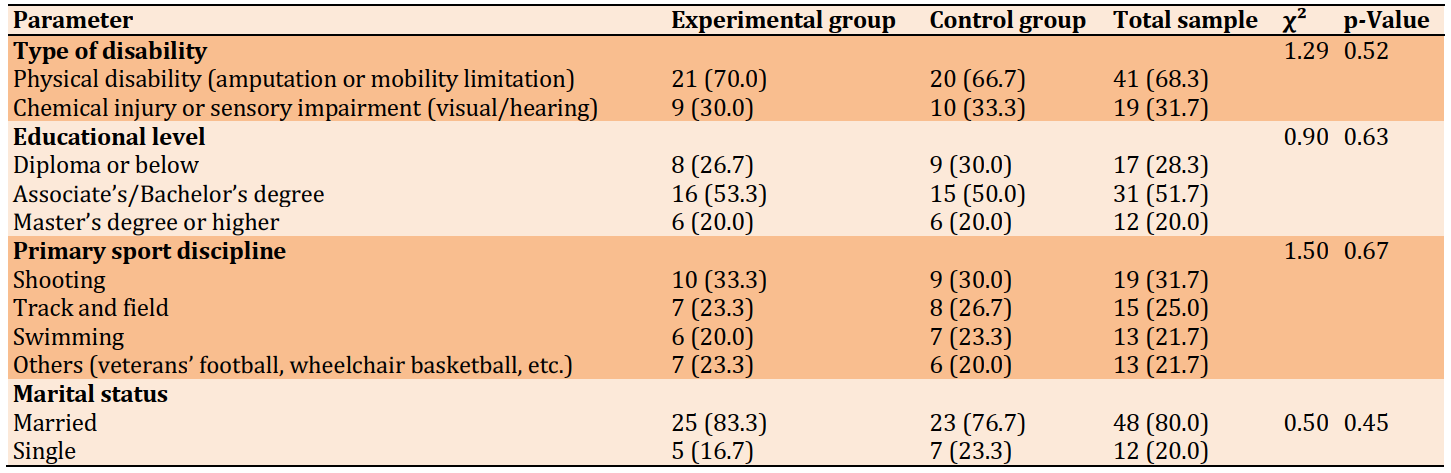
A total of 60 male veteran athletes participated in the present study. The participants had a mean age of 42.95±5.92 years and an average duration of veteran status of 10.2±4.5 years. The mean duration of regular sports participation was 9.63±3.20 years. Participants were assigned to an experimental group (n=30) and a control group (n=30). Baseline characteristics were comparable across groups, including age, disability rating, and sports experience (Table 2).
Baseline comparisons also indicated no significant group differences in state anxiety, trait anxiety, and sleep quality (PSQI). Participants in both groups were primarily experienced athletes who actively competed in sports events organized by the Mazandaran Veterans and Disabled Sports Federation, with average ages falling approximately within the 35–60-year range; no significant demographic differences were found between groups (p>0.05).
Paired-samples t-tests demonstrated significant improvements from pre-test to post-test in all outcome parameters for the intervention group (p<0.001), including reductions in both state anxiety and trait anxiety and improvements in sleep quality, mindful attention awareness (MAAS), and body awareness (BAQ). In contrast, the control group showed no significant changes across any measured parameters (p>0.05). Additionally, baseline independent-samples t-tests indicated no significant between-group differences on any study variable (p>0.05), confirming the initial equivalence of the two groups.
Table 2. Comparison of demographic characteristics of participants
The ANCOVA results, after controlling for pre-test scores, indicated significant post-test differences between the intervention and control groups for state anxiety, trait anxiety, and sleep quality (p<0.001). The effect sizes suggested a substantial impact of the intervention, with partial eta squared values of 0.24 for state anxiety, 0.22 for trait anxiety, and 0.27 for sleep quality. Paired-samples t-tests further showed significant pre-test to post-test improvements within the intervention group in anxiety, sleep quality, mindful awareness, and body awareness (p<0.001). The control group did not show significant changes in any parameters (p>0.05).
In the intervention group, paired-samples t-tests showed significant reductions in anxiety and improvements in sleep quality from pre-test to post-test, along with significant increases in mindful awareness (MAAS) over time (all p<0.001). These improvements were also reflected in the time-dependent comparisons across pre-test, post-test, and follow-up: state anxiety (F=17.5, p<0.001), trait anxiety (F=16.0, p<0.001), sleep quality as measured by PSQI (F=19.2, p<0.001), and MAAS (F=18.5, p<0.001) all demonstrated statistically significant change over time. No significant changes were observed in the control group (p>0.05).
In the intervention group, MAAS increased from 3.2±0.5 (pre-test) to 4.1±0.4 (post-test) and remained elevated at 4.0±0.4 at follow-up; this change was significant (paired t=10.3, p<0.001). BAQ increased from 3.0±0.6 (pre-test) to 4.0±0.5 (post-test) and stayed improved at 3.9±0.5 at follow-up; this was also significant (paired t=9.8, p<0.001).
Discussion
This study examined the effect of an eight-week mindfulness and body awareness training program on anxiety and sleep quality among male veteran athletes. Participation in the intervention resulted in significant reductions in both state and trait anxiety, as well as significant improvements in sleep quality. In addition, participants in the intervention group showed significant increases in mindful awareness (MAAS) and body awareness (BAQ). The observed effects were largely maintained at the four-week follow-up assessment, suggesting that the benefits of the intervention persisted beyond the active training period. Furthermore, indicated that the intervention had both statistical significance and practical relevance for psychological well-being and sleep-related outcomes in this population.
These findings are consistent with a growing body of research supporting the effectiveness of mindfulness-based interventions in sport and health settings. For example, Gao et al. reported that mindfulness-based interventions contribute to reductions in anxiety and improvements in emotional regulation among athletes [11]. Similarly, Jones et al. found that MBSR programs are associated with enhanced sleep quality and psychological well-being [12]. Furthermore, Hut et al. demonstrated that mindfulness training improves psychological functioning and reduces perceived stress among university athletes. The convergence of our findings with previous evidence suggests that the benefits of mindfulness-related interventions extend across diverse athletic populations, including veteran athletes [23].
Several mechanisms may explain the observed reductions in anxiety. Contemporary models of mindfulness propose that training attention toward present-moment experiences enhances emotional regulation and reduces maladaptive cognitive processing associated with anxiety [4]. Mindfulness practices may improve the ability to observe thoughts and emotions without excessive reactivity, thereby weakening automatic threat-related processing. In addition, evidence suggests that mindfulness training may influence stress-related physiological systems, including modulation of the hypothalamic-pituitary-adrenal (HPA) axis and reductions in cortisol secretion, leading to improved emotional regulation and reduced anxiety symptoms [24]. Neuroimaging studies have also reported increased activation of prefrontal regulatory regions and decreased amygdala reactivity following mindfulness training—changes that are associated with enhanced cognitive control over emotional responses [10].
The improvements in sleep quality may be explained by both psychological and physiological mechanisms. Mindfulness and body awareness practices are thought to reduce physiological hyperarousal and promote parasympathetic nervous system activity, thereby facilitating sleep initiation and maintenance. Body awareness exercises may further contribute by reducing muscular tension, improving breathing regulation, and enhancing awareness of bodily states associated with relaxation [6, 25]. These findings are consistent with studies conducted among military personnel and veterans, which have identified heightened physiological arousal and persistent threat-system activation as major contributors to sleep disturbances [2]. Moreover, reductions in anxiety may indirectly improve sleep quality by decreasing cognitive arousal and rumination before sleep [3].
There was a significant increase in mindful awareness and body awareness following the intervention. These changes suggest that participants developed greater attentional control and enhanced awareness of internal bodily experiences. Improvements in attentional regulation and interoceptive awareness may represent important mechanisms through which mindfulness-based interventions exert their therapeutic effects [26, 27]. Therefore, the observed increases in MAAS and BAQ scores may reflect changes in self-regulatory processes that contribute to improved psychological functioning and sleep-related outcomes. Importantly, the intervention may have influenced not only symptom reduction but also underlying capacities related to emotional regulation and adaptive coping.
The maintenance of intervention effects at follow-up further strengthens the clinical relevance of the findings. The relative stability of improvements in anxiety, sleep quality, mindful awareness, and body awareness suggests that participants may have continued to apply the skills acquired during training after the formal intervention ended. This observation is consistent with systematic reviews indicating that mindfulness-based interventions can produce durable improvements by fostering long-term self-regulation, present-moment awareness, and emotional resilience [7]. From this perspective, the sustained effects observed in the present study may reflect the gradual integration of mindfulness and body awareness skills into participants’ daily lives.
These findings may be particularly relevant for veteran athletes, who often face unique psychological and physical challenges associated with combat-related injuries, chronic pain, functional limitations, and competitive sport demands. These factors may increase vulnerability to anxiety, stress, and sleep disturbances. Mindfulness and body awareness training may address several of these challenges simultaneously by enhancing emotional regulation, reducing physiological stress responses, and promoting adaptive coping strategies. Consequently, such interventions may represent a valuable complementary approach within psychological rehabilitation and athlete-support programs for veterans.
A notable strength of the present study was its focus on male veteran athletes, a population that has received relatively limited attention within the mindfulness literature. Although previous investigations have primarily examined non-athlete veterans or general clinical populations, the current findings extend existing evidence to a unique group of individuals who experience both athletic and disability-related challenges. Additionally, the inclusion of a control group and a follow-up assessment strengthened the study’s methodological rigor and allowed for the evaluation of the sustainability of intervention effects.
The intervention was also associated with increased mindful awareness and body awareness, suggesting potential mechanisms underlying these positive outcomes. The maintenance of improvements at follow-up further supports the potential value of mindfulness- and body awareness-based approaches as practical and cost-effective strategies for enhancing psychological well-being and sleep health in veteran athlete populations. Further research with larger samples and longer follow-up periods is recommended to confirm and extend these findings.
Despite the promising findings, several limitations should be considered when interpreting the results of the present study. First, the sample size was relatively small, and all participants were male veteran athletes from a single province in Iran. Therefore, caution should be exercised when generalizing the findings to female veterans, non-athlete veterans, or populations from different cultural and geographical contexts.
Second, the study relied primarily on self-report measures to assess anxiety, sleep quality, mindful awareness, and body awareness. Although the instruments used demonstrated acceptable psychometric properties, self-report data may be subject to response bias, social desirability effects, and individual differences in self-perception. Future studies may benefit from incorporating objective measures of sleep, such as actigraphy or polysomnography, as well as physiological indicators of stress and emotional regulation. Third, the follow-up period was relatively short. Although the intervention effects remained largely stable four weeks after the completion of the program, longer follow-up assessments are needed to determine the long-term sustainability of these improvements and to evaluate whether continued practice is necessary for maintaining benefits over time.
In addition, it was not possible to fully control several potentially influential parameters, including medication use, chronic pain severity, previous sleep difficulties, and individual differences in adherence to home-based practice. These factors may have influenced the observed outcomes and should be addressed in future research.
Finally, although significant increases in mindful awareness and body awareness were observed following the intervention, this study did not directly examine the mechanisms through which these changes contributed to improvements in anxiety and sleep quality. Future research employing mediation analyses and longitudinal designs may help clarify the psychological and physiological processes underlying the effectiveness of mindfulness- and body awareness-based interventions in veteran athlete populations.
Conclusion
An eight-week mindfulness and body awareness program is effective in reducing state and trait anxiety and improving sleep quality among male veteran athletes.
Acknowledgments: We sincerely thank all the esteemed mothers who, with their patience and cooperation, made a valuable contribution to this research.
Ethical Permissions: The study received ethical approval from the National Research Ethics Committee of Islamic Azad University, Sari Branch (IR.IAU.SARI.REC.1405.049).
Conflicts of Interest: The authors declared no conflicts of interest.
Authors' Contribution: Safaei I (First Author), Discussion Writer (30%); Ahmadi M (Second Author), Statistical Analyst (15%); Soleymani Tapesari B (Third Author), Introduction Writer (15%); Vahid Shojaei V (Fourth Author), Methodologist/Main Researcher (30%); Ozgoli A (Fifth Author), Assistant Researcher (10%)
Funding/Support: No funding was received for this study.
Veterans constitute a population at elevated risk for psychological difficulties and sleep disturbances. Exposure to combat-related trauma, physical disabilities, chronic pain, and psychosocial stressors may contribute to the development and persistence of anxiety symptoms and sleep-related problems in this population [1]. Anxiety and insomnia are among the most prevalent mental health concerns among veterans, and these conditions exhibit a bidirectional relationship. Increased anxiety may impair sleep quality, while sleep disturbances can exacerbate anxiety symptoms [2, 3]. This issue is particularly important among veteran athletes, as inadequate sleep and elevated anxiety may adversely affect physical recovery, concentration, psychological readiness, and athletic performance. High levels of anxiety are associated with increased physiological arousal, cognitive worry, and impaired attentional control, thereby negatively influencing athletic performance, physical recovery, and psychological well-being. Given the reciprocal relationship between anxiety and sleep, heightened anxiety may further compromise physical recovery, concentration, and psychological preparedness among veteran athletes. Moreover, anxiety may disrupt both sleep initiation and sleep maintenance through increased rumination and autonomic arousal [3]. Consequently, anxiety reduction has become a primary target of mental health interventions designed for veteran athletes.
In recent years, mindfulness- and body awareness-based interventions have received considerable attention as effective approaches for promoting psychological well-being and enhancing performance in both athletic and clinical populations. Mindfulness refers to the process of intentionally attending to present-moment experiences with an attitude of acceptance and nonjudgment, and it forms the core component of interventions, such as mindfulness-based stress reduction (MBSR) [4, 5]. Body awareness, in contrast, refers to the capacity to perceive and monitor internal bodily sensations, breathing patterns, and physiological changes, and it plays a critical role in emotion regulation and stress reduction [6]. The simultaneous enhancement of mental and bodily awareness may improve psychological adjustment, reduce anxiety, and promote better sleep quality [7]. Furthermore, a recent systematic review and meta-analysis reported that mindfulness-based interventions, embodiment practices, and cognitive strategies can produce significant reductions in state anxiety and represent some of the most effective short-term approaches for anxiety management [8].
Mindfulness interventions, which incorporate attentional training, body awareness exercises, and nonjudgmental acceptance of moment-to-moment experiences, have demonstrated effectiveness in sport settings by enhancing emotional regulation, improving attentional focus, and reducing performance- and competition-related anxiety [9].
From a neurobiological perspective, evidence indicates that mindfulness practices may regulate neural networks involved in attention, emotion processing, and self-regulation. Neuroimaging studies have reported reduced amygdala activation and increased engagement of prefrontal cortical regions following mindfulness training; these changes are associated with improved emotional control and reduced anxiety [10]. In addition, mindfulness may enhance sleep quality by modulating hypothalamic-pituitary-adrenal (HPA) axis activity and attenuating physiological stress responses [4]. Similarly, body awareness practices facilitate greater sensitivity to bodily signals and promote parasympathetic nervous system activation, thereby contributing to reduced physiological arousal, improved emotion regulation, and enhanced sleep quality [6].
Mindfulness and body awareness interventions, whether implemented independently or in combination, are effective in improving mental health outcomes, including anxiety, depression, and sleep quality [6, 7]. Research further indicates that integrated mind-body interventions can alleviate anxiety, stress, and sleep disturbances across athletic, military, and clinical populations [11, 12]. Studies involving veterans have similarly demonstrated that mind-body interventions can reduce stress, anxiety, and sleep-related symptoms while enhancing psychological adaptation and resilience [7, 13]. Mindfulness-based, body awareness-based, and related mind-body interventions are associated with improved mental health, reduced anxiety, and enhanced sleep quality across diverse populations [6]. Nevertheless, empirical evidence regarding the effectiveness of integrated mindfulness and body awareness programs among veteran athletes, particularly within non-Western cultural contexts, remains limited.
Despite promising findings concerning the effectiveness of mindfulness- and body awareness-based interventions, several important research gaps remain. First, most previous studies have focused on general populations, healthy athletes, or non-athlete veterans, whereas intervention studies specifically targeting veteran athletes remain scarce [14].
Second, most available evidence has been generated in Western countries, and little is known about the effectiveness of these interventions in different cultural settings, including the Iranian veteran population [15]. Furthermore, evidence concerning integrated mindfulness and body awareness interventions among athletes with disabilities, particularly within Middle Eastern societies, is limited. Additionally, most previous studies have
examined mindfulness and body awareness separately, with relatively few investigations assessing the effects of integrated mind-body programs on both anxiety and sleep quality simultaneously. Therefore, despite growing evidence supporting the benefits of mindfulness and body awareness interventions for psychological outcomes, research examining the effectiveness of integrated mindfulness and body awareness programs among veteran athletes remains limited. Moreover, existing evidence is predominantly derived from Western populations, which restricts the generalizability of findings to other cultural contexts [9, 15].
Given the high prevalence of anxiety and sleep disturbances among veteran athletes, the importance of mental health for maintaining athletic performance and quality of life, and the limited empirical evidence regarding the effectiveness of integrated mindfulness and body awareness interventions in this population, further investigation is warranted. Accordingly, this study aimed to examine the effectiveness of an eight-week mindfulness and body awareness program in reducing anxiety and improving sleep quality among male veteran athletes. Specifically, the study sought to determine whether participation in this program would lead to significant reductions in anxiety and improvements in sleep quality within this population.
Materials and Methods
Design and participants
This quasi-experimental study employed a pretest–post-test design with a control group and was conducted among male veteran athletes from Mazandaran Province, Iran, in 2026.
The sample consisted of all male veteran athletes residing in Mazandaran Province who were actively participating in sports programs organized by the Veterans and Disabled Sports Federations during 2026. According to records from the Foundation of Martyrs and Veterans Affairs, approximately 450 veteran athletes were registered in these organizations during the study period.
Participants were selected using purposive convenience sampling. Participants were then randomly assigned through a simple lottery procedure to either the experimental group (n=30) or the control group (n=30). Random allocation was used to minimize selection bias and enhance baseline equivalence between the groups. Consequently, the two groups were comparable with respect to demographic characteristics and baseline study parameters.
The inclusion criteria were possession of a valid veteran identification card issued by the Foundation of Martyrs and Veterans Affairs, a minimum of two years of regular sports participation, age between 30 and 55 years, residence in Mazandaran Province, absence of severe psychiatric disorders according to medical records, and willingness to participate voluntarily in the training sessions.
The exclusion criteria were absence from more than two intervention sessions, use of sedative or hypnotic medications during the intervention period, development of a new physical or psychological disorder during the study, and failure to complete the study questionnaires.
Procedure
The study was conducted in accordance with ethical principles for human research and was approved by the institutional ethics committee. Before participation, all individuals provided written informed consent and were assured of confidentiality.
The intervention consisted of an eight-week mindfulness and body awareness training program for the experimental group. Sessions were delivered twice weekly, each lasting 90 minutes, in a multipurpose sports facility affiliated with the Mazandaran Department of Youth and Sports. Each session included 30 minutes of psychoeducation, 45 minutes of guided practice, and 15 minutes of group discussion, and was facilitated by a certified sports psychologist. The program was based on the mindfulness and body awareness approach associated with MBSR principles (Kabat-Zinn and Hanh [5]) and included mindful breathing, body scans, seated meditation, attention to bodily sensations, yoga-based movements, and nonjudgmental acceptance of thoughts and emotions. Participants received guided meditation audio recordings, a daily practice workbook, and weekly self-monitoring forms, and were instructed to complete at least 20 minutes of home practice daily.
Adherence and completion were assessed weekly through submission of practice journals documenting assigned exercises and emotional changes. To monitor intervention quality, brief semi-structured interviews were conducted during weeks 4 and 8 to evaluate attentional focus and emotional acceptance. The control group received no intervention and attended only the assessment sessions.
At baseline (pre-test), all participants completed the State-Trait Anxiety Inventory (STAI) and the Pittsburgh Sleep Quality Index (PSQI). The same measures were administered again after the intervention (post-test).
Instrument
State-Trait Anxiety Inventory (STAI)
Anxiety was assessed using the State-Trait Anxiety Inventory (STAI), developed by Spielberger & Gorsuch [16]. The instrument consists of 40 items divided into two 20-item subscales measuring state anxiety and trait anxiety, respectively. State anxiety reflects transient emotional reactions experienced at a particular moment, whereas trait anxiety assesses a relatively stable tendency to perceive situations as threatening. Items are rated on a four-point Likert scale, with higher scores indicating greater levels of anxiety.
Previous research has demonstrated satisfactory psychometric properties of the STAI, with Cronbach’s alpha coefficients generally exceeding 0.85 for both subscales [16]. In addition, evidence supporting its construct validity and convergent validity has been reported across numerous studies, showing significant correlations with other measures of anxiety [17]. In Iran, Dehshiri et al. reported Cronbach’s alpha coefficients of approximately 0.90 for both subscales and confirmed the instrument’s two-factor structure [18].
Table 1. Eight-week mindfulness and body awareness training program for veteran athletes
Pittsburgh Sleep Quality Index (PSQI)
Buysse et al. developed the Pittsburgh Sleep Quality Index (PSQI), which was used to assess sleep quality [19]. The PSQI evaluates sleep quality over the preceding month and consists of 19 self-report items grouped into seven components, including subjective sleep quality, sleep latency, sleep duration, habitual sleep efficiency, sleep disturbances, use of sleep medication, and daytime dysfunction. Each component is scored on a scale ranging from 0 to 3, yielding a global score between 0 and 21. Higher scores indicate poorer sleep quality.
The PSQI is among the most widely used measures of sleep quality in both clinical and sports-related research and has demonstrated satisfactory psychometric properties across diverse populations. The original validation study reported acceptable internal consistency (Cronbach’s α=0.83), as well as satisfactory convergent validity with both subjective and objective indicators of sleep quality.
The Persian version of the PSQI has also demonstrated favorable psychometric characteristics. Farrahi Moghaddam et al. reported Cronbach’s alpha coefficients ranging from 0.80 to 0.86 and confirmed its construct validity and ability to discriminate between individuals with good and poor sleep quality [20].
Mindful Attention Awareness Scale (MAAS)
Although anxiety and sleep quality were the primary outcomes, mindful awareness was also assessed to examine potential changes associated with participation in the intervention. The MAAS, developed by Brown & Ryan, is a 15-item self-report measure that assesses the tendency to attend to and be aware of present-moment experiences. Items are rated on a 6-point Likert scale, with higher scores indicating greater mindful awareness. Previous studies have demonstrated satisfactory reliability and validity of the scale across diverse populations [21].
Body Awareness Questionnaire (BAQ)
Body awareness was also assessed as a secondary outcome measure using the Body Awareness Questionnaire developed by Shields et al. The BAQ consists of 18 items designed to evaluate awareness of internal bodily sensations and normal physiological processes. Responses are recorded on a Likert-type scale, with higher scores reflecting greater body awareness. The instrument has demonstrated acceptable psychometric properties in previous research. In addition to the primary outcomes (state anxiety, trait anxiety, and sleep quality), mindful awareness and body awareness were assessed as secondary outcome measures to explore potential mechanisms associated with intervention-related changes [22].
Data analysis
Data were analyzed using SPSS 26. The normality of data distributions was assessed using the Shapiro-Wilk test. Homogeneity of variances was evaluated using Levene’s test, and the assumption of homogeneity of regression slopes was examined before conducting analysis of covariance (ANCOVA). All assumptions were adequately satisfied.
To compare post-test scores of state anxiety, trait anxiety, and sleep quality between the experimental and control groups while controlling for baseline differences, separate one-way analyses of covariance (ANCOVA) were performed using pre-test scores as covariates. Within-group changes from pre-test to post-test were examined using paired-samples t-tests. Effect sizes were calculated using eta squared (η²) and, where appropriate, partial eta squared (ηp²). Corresponding 95% confidence intervals (95% CI) were also reported.
Findings
A total of 60 male veteran athletes participated in the present study. The participants had a mean age of 42.95±5.92 years and an average duration of veteran status of 10.2±4.5 years. The mean duration of regular sports participation was 9.63±3.20 years. Participants were assigned to an experimental group (n=30) and a control group (n=30). Baseline characteristics were comparable across groups, including age, disability rating, and sports experience (Table 2).
Baseline comparisons also indicated no significant group differences in state anxiety, trait anxiety, and sleep quality (PSQI). Participants in both groups were primarily experienced athletes who actively competed in sports events organized by the Mazandaran Veterans and Disabled Sports Federation, with average ages falling approximately within the 35–60-year range; no significant demographic differences were found between groups (p>0.05).
Paired-samples t-tests demonstrated significant improvements from pre-test to post-test in all outcome parameters for the intervention group (p<0.001), including reductions in both state anxiety and trait anxiety and improvements in sleep quality, mindful attention awareness (MAAS), and body awareness (BAQ). In contrast, the control group showed no significant changes across any measured parameters (p>0.05). Additionally, baseline independent-samples t-tests indicated no significant between-group differences on any study variable (p>0.05), confirming the initial equivalence of the two groups.
Table 2. Comparison of demographic characteristics of participants
The ANCOVA results, after controlling for pre-test scores, indicated significant post-test differences between the intervention and control groups for state anxiety, trait anxiety, and sleep quality (p<0.001). The effect sizes suggested a substantial impact of the intervention, with partial eta squared values of 0.24 for state anxiety, 0.22 for trait anxiety, and 0.27 for sleep quality. Paired-samples t-tests further showed significant pre-test to post-test improvements within the intervention group in anxiety, sleep quality, mindful awareness, and body awareness (p<0.001). The control group did not show significant changes in any parameters (p>0.05).
In the intervention group, paired-samples t-tests showed significant reductions in anxiety and improvements in sleep quality from pre-test to post-test, along with significant increases in mindful awareness (MAAS) over time (all p<0.001). These improvements were also reflected in the time-dependent comparisons across pre-test, post-test, and follow-up: state anxiety (F=17.5, p<0.001), trait anxiety (F=16.0, p<0.001), sleep quality as measured by PSQI (F=19.2, p<0.001), and MAAS (F=18.5, p<0.001) all demonstrated statistically significant change over time. No significant changes were observed in the control group (p>0.05).
In the intervention group, MAAS increased from 3.2±0.5 (pre-test) to 4.1±0.4 (post-test) and remained elevated at 4.0±0.4 at follow-up; this change was significant (paired t=10.3, p<0.001). BAQ increased from 3.0±0.6 (pre-test) to 4.0±0.5 (post-test) and stayed improved at 3.9±0.5 at follow-up; this was also significant (paired t=9.8, p<0.001).
Discussion
This study examined the effect of an eight-week mindfulness and body awareness training program on anxiety and sleep quality among male veteran athletes. Participation in the intervention resulted in significant reductions in both state and trait anxiety, as well as significant improvements in sleep quality. In addition, participants in the intervention group showed significant increases in mindful awareness (MAAS) and body awareness (BAQ). The observed effects were largely maintained at the four-week follow-up assessment, suggesting that the benefits of the intervention persisted beyond the active training period. Furthermore, indicated that the intervention had both statistical significance and practical relevance for psychological well-being and sleep-related outcomes in this population.
These findings are consistent with a growing body of research supporting the effectiveness of mindfulness-based interventions in sport and health settings. For example, Gao et al. reported that mindfulness-based interventions contribute to reductions in anxiety and improvements in emotional regulation among athletes [11]. Similarly, Jones et al. found that MBSR programs are associated with enhanced sleep quality and psychological well-being [12]. Furthermore, Hut et al. demonstrated that mindfulness training improves psychological functioning and reduces perceived stress among university athletes. The convergence of our findings with previous evidence suggests that the benefits of mindfulness-related interventions extend across diverse athletic populations, including veteran athletes [23].
Several mechanisms may explain the observed reductions in anxiety. Contemporary models of mindfulness propose that training attention toward present-moment experiences enhances emotional regulation and reduces maladaptive cognitive processing associated with anxiety [4]. Mindfulness practices may improve the ability to observe thoughts and emotions without excessive reactivity, thereby weakening automatic threat-related processing. In addition, evidence suggests that mindfulness training may influence stress-related physiological systems, including modulation of the hypothalamic-pituitary-adrenal (HPA) axis and reductions in cortisol secretion, leading to improved emotional regulation and reduced anxiety symptoms [24]. Neuroimaging studies have also reported increased activation of prefrontal regulatory regions and decreased amygdala reactivity following mindfulness training—changes that are associated with enhanced cognitive control over emotional responses [10].
The improvements in sleep quality may be explained by both psychological and physiological mechanisms. Mindfulness and body awareness practices are thought to reduce physiological hyperarousal and promote parasympathetic nervous system activity, thereby facilitating sleep initiation and maintenance. Body awareness exercises may further contribute by reducing muscular tension, improving breathing regulation, and enhancing awareness of bodily states associated with relaxation [6, 25]. These findings are consistent with studies conducted among military personnel and veterans, which have identified heightened physiological arousal and persistent threat-system activation as major contributors to sleep disturbances [2]. Moreover, reductions in anxiety may indirectly improve sleep quality by decreasing cognitive arousal and rumination before sleep [3].
There was a significant increase in mindful awareness and body awareness following the intervention. These changes suggest that participants developed greater attentional control and enhanced awareness of internal bodily experiences. Improvements in attentional regulation and interoceptive awareness may represent important mechanisms through which mindfulness-based interventions exert their therapeutic effects [26, 27]. Therefore, the observed increases in MAAS and BAQ scores may reflect changes in self-regulatory processes that contribute to improved psychological functioning and sleep-related outcomes. Importantly, the intervention may have influenced not only symptom reduction but also underlying capacities related to emotional regulation and adaptive coping.
The maintenance of intervention effects at follow-up further strengthens the clinical relevance of the findings. The relative stability of improvements in anxiety, sleep quality, mindful awareness, and body awareness suggests that participants may have continued to apply the skills acquired during training after the formal intervention ended. This observation is consistent with systematic reviews indicating that mindfulness-based interventions can produce durable improvements by fostering long-term self-regulation, present-moment awareness, and emotional resilience [7]. From this perspective, the sustained effects observed in the present study may reflect the gradual integration of mindfulness and body awareness skills into participants’ daily lives.
These findings may be particularly relevant for veteran athletes, who often face unique psychological and physical challenges associated with combat-related injuries, chronic pain, functional limitations, and competitive sport demands. These factors may increase vulnerability to anxiety, stress, and sleep disturbances. Mindfulness and body awareness training may address several of these challenges simultaneously by enhancing emotional regulation, reducing physiological stress responses, and promoting adaptive coping strategies. Consequently, such interventions may represent a valuable complementary approach within psychological rehabilitation and athlete-support programs for veterans.
A notable strength of the present study was its focus on male veteran athletes, a population that has received relatively limited attention within the mindfulness literature. Although previous investigations have primarily examined non-athlete veterans or general clinical populations, the current findings extend existing evidence to a unique group of individuals who experience both athletic and disability-related challenges. Additionally, the inclusion of a control group and a follow-up assessment strengthened the study’s methodological rigor and allowed for the evaluation of the sustainability of intervention effects.
The intervention was also associated with increased mindful awareness and body awareness, suggesting potential mechanisms underlying these positive outcomes. The maintenance of improvements at follow-up further supports the potential value of mindfulness- and body awareness-based approaches as practical and cost-effective strategies for enhancing psychological well-being and sleep health in veteran athlete populations. Further research with larger samples and longer follow-up periods is recommended to confirm and extend these findings.
Despite the promising findings, several limitations should be considered when interpreting the results of the present study. First, the sample size was relatively small, and all participants were male veteran athletes from a single province in Iran. Therefore, caution should be exercised when generalizing the findings to female veterans, non-athlete veterans, or populations from different cultural and geographical contexts.
Second, the study relied primarily on self-report measures to assess anxiety, sleep quality, mindful awareness, and body awareness. Although the instruments used demonstrated acceptable psychometric properties, self-report data may be subject to response bias, social desirability effects, and individual differences in self-perception. Future studies may benefit from incorporating objective measures of sleep, such as actigraphy or polysomnography, as well as physiological indicators of stress and emotional regulation. Third, the follow-up period was relatively short. Although the intervention effects remained largely stable four weeks after the completion of the program, longer follow-up assessments are needed to determine the long-term sustainability of these improvements and to evaluate whether continued practice is necessary for maintaining benefits over time.
In addition, it was not possible to fully control several potentially influential parameters, including medication use, chronic pain severity, previous sleep difficulties, and individual differences in adherence to home-based practice. These factors may have influenced the observed outcomes and should be addressed in future research.
Finally, although significant increases in mindful awareness and body awareness were observed following the intervention, this study did not directly examine the mechanisms through which these changes contributed to improvements in anxiety and sleep quality. Future research employing mediation analyses and longitudinal designs may help clarify the psychological and physiological processes underlying the effectiveness of mindfulness- and body awareness-based interventions in veteran athlete populations.
Conclusion
An eight-week mindfulness and body awareness program is effective in reducing state and trait anxiety and improving sleep quality among male veteran athletes.
Acknowledgments: We sincerely thank all the esteemed mothers who, with their patience and cooperation, made a valuable contribution to this research.
Ethical Permissions: The study received ethical approval from the National Research Ethics Committee of Islamic Azad University, Sari Branch (IR.IAU.SARI.REC.1405.049).
Conflicts of Interest: The authors declared no conflicts of interest.
Authors' Contribution: Safaei I (First Author), Discussion Writer (30%); Ahmadi M (Second Author), Statistical Analyst (15%); Soleymani Tapesari B (Third Author), Introduction Writer (15%); Vahid Shojaei V (Fourth Author), Methodologist/Main Researcher (30%); Ozgoli A (Fifth Author), Assistant Researcher (10%)
Funding/Support: No funding was received for this study.
Keywords:
References
1. Steenkamp MM, Litz BT, Hoge CW, Marmar CR. Psychotherapy for military-related PTSD: A review of randomized clinical trials. JAMA. 2015;314(5):489-500. [Link] [DOI:10.1001/jama.2015.8370]
2. Jones MB, Tea J, Meyers M, Li R, Villalon A, Agrawal R, et al. Rates and predictors of rapid eye movement sleep behavior disorder symptoms among post-9/11 veterans. J Neuropsychiatry Clin Neurosci. 2024;36(4):325-32. [Link] [DOI:10.1176/appi.neuropsych.20230106]
3. Leech K, Stapleton P, Patching A. A roadmap to understanding interoceptive awareness and post-traumatic stress disorder: A scoping review. Front Psychiatry. 2024;15:1355442. [Link] [DOI:10.3389/fpsyt.2024.1355442]
4. Creswell JD. Mindfulness interventions. Annu Rev Psychol. 2017;68:491-516. [Link] [DOI:10.1146/annurev-psych-042716-051139]
5. Kabat-Zinn J, Hanh TN. Full catastrophe living: Using the wisdom of your body and mind to face stress, pain, and illness. New York: Delta; 2009. [Link]
6. Möllmann A, Heinrichs N, Herwig A. A conceptual framework on body representations and their relevance for mental disorders. Front Psychol. 2024;14:1231640. [Link] [DOI:10.3389/fpsyg.2023.1231640]
7. Goldberg SB, Riordan KM, Sun S, Davidson RJ. The empirical status of mindfulness-based interventions: A systematic review of 44 meta-analyses of randomized controlled trials. Perspect Psychol Sci. 2022;17(1):108-30. [Link] [DOI:10.1177/1745691620968771]
8. Chin P, Gorman F, Beck F, Russell BR, Stephan KE, Harrison OK. A systematic review of brief respiratory, embodiment, cognitive, and mindfulness interventions to reduce state anxiety. Front Psychol. 2024;15:1412928. [Link] [DOI:10.3389/fpsyg.2024.1412928]
9. Rogowska AM, Tataruch R. The relationship between mindfulness and athletes' mental skills may be explained by emotion regulation and self-regulation. BMC Sports Sci Med Rehabil. 2024;16(1):68-79. [Link] [DOI:10.1186/s13102-024-00863-z]
10. Tang YY, Hölzel BK, Posner MI. The neuroscience of mindfulness meditation. Nat Rev Neurosci. 2015;16(4):213-25. [Link] [DOI:10.1038/nrn3916]
11. Gao Y, Shi L, Fu N, Yang N, Weeks-Gariepy T, Mao Y. Mobile-delivered mindfulness intervention on anxiety level among college athletes: Randomized controlled trial. J Med Internet Res. 2024;26:e40406. [Link] [DOI:10.2196/40406]
12. Jones BJ, Kaur S, Miller M, Spencer RM. Mindfulness-based stress reduction benefits psychological well-being, sleep quality, and athletic performance in female collegiate rowers. Front Psychol. 2020;11:572980. [Link] [DOI:10.3389/fpsyg.2020.572980]
13. Cushing RE, Braun KL. Mind-body therapy for military veterans with post-traumatic stress disorder: A systematic review. J Altern Complement Med. 2018;24(2):106-14. [Link] [DOI:10.1089/acm.2017.0176]
14. Peters DM, Høigaard R, Francis JW. Editorial: Adapted & (dis)ability sport. Front Psychol. 2024;15:1515330. [Link] [DOI:10.3389/fpsyg.2024.1515330]
15. Ghasemi SM, Feiznia Z, Karbasi T, Roostaee M, Alipour Azami Z, Hosseini Arian N, et al. Cognitive analytic therapy for the treatment of post-traumatic stress disorder: A randomized controlled trial. Nord J Psychiatry. 2024;78(6):489-96. [Link] [DOI:10.1080/08039488.2024.2360978]
16. Spielberger CD, Gorsuch RL. Manual for the state-trait anxiety inventory (form Y1-Y2). Palo Alto, CA: Consulting Psychologists Press; 1983. [Link] [DOI:10.1037/t06496-000]
17. Julian LJ. Measures of anxiety: State-Trait Anxiety Inventory (STAI), Beck Anxiety Inventory (BAI), and Hospital Anxiety and Depression Scale-Anxiety (HADS-A). Arthritis Care Res. 2011;63(11):S467-72. [Link] [DOI:10.1002/acr.20561]
18. Dehshiri G, Rastegar S, Ghaffari M. Psychometric properties of the Persian version of the State-Trait Anxiety Inventory (STAI) in university students. J Iran Psychol. 2008;4(16):23-39. [Link]
19. Buysse DJ, Reynolds CF 3rd, Monk TH, Berman SR, Kupfer DJ. The Pittsburgh sleep quality index: A new instrument for psychiatric practice and research. Psychiatry Res. 1989;28(2):193-213. [Link] [DOI:10.1016/0165-1781(89)90047-4]
20. Farrahi Moghaddam J, Nakhaee N, Sheibani V, Garrusi B, Amirkafi A. Reliability and validity of the Persian version of the Pittsburgh Sleep Quality Index (PSQI-P). Sleep Breath. 2012;16(1):79-82. [Link] [DOI:10.1007/s11325-010-0478-5]
21. Brown KW, Ryan RM. The benefits of being present: Mindfulness and its role in psychological well-being. J Pers Soc Psychol. 2003;84(4):822-48. [Link] [DOI:10.1037/0022-3514.84.4.822]
22. Shields SA, Mallory ME, Simon A. The body awareness questionnaire: Reliability and validity. J Personal Assess. 1989;53(4):802-15. [Link] [DOI:10.1207/s15327752jpa5304_16]
23. Hut M, Minkler TO, Glass CR, Weppner CH, Thomas HM, Flannery CB. A randomized controlled study of mindful sport performance enhancement and psychological skills training with collegiate track and field athletes. J Appl Sport Psychol. 2023;35(2):284-306. [Link] [DOI:10.1080/10413200.2021.1989521]
24. Mousavi E, Sadeghi-Bahmani D, Khazaie H, Brühl AB, Stanga Z, Brand S. The effect of a modified mindfulness-based stress reduction (MBSR) program on symptoms of stress and depression and on saliva cortisol and serum Creatine kinase among male wrestlers. Healthcare. 2023;11(11):1643. [Link] [DOI:10.3390/healthcare11111643]
25. Van Es VAA, De Lathauwer ILJ, Kemps HMC, Handjaras G, Betta M. Remote monitoring of sympathovagal imbalance during sleep and its implications in cardiovascular risk assessment: A systematic review. Bioengineering. 2024;11(10):1045. [Link] [DOI:10.3390/bioengineering11101045]
26. Farb N, Daubenmier J, Price CJ, Gard T, Kerr C, Dunn BD, et al. Interoception, contemplative practice, and health. Front Psychol. 2015;6:763. [Link] [DOI:10.3389/fpsyg.2015.00763]
27. Treves IN, Chen YY, Wilson CL, Verdonk C, Qina'au J, Pustejovsky JE, et al. Minding the body: A meta-analysis of the effects of mindfulness meditation training on self-reported interoception. Res Sq. 2025:rs.3.rs-6792067. [Link] [DOI:10.21203/rs.3.rs-6792067/v1]