

JMERC
Owner
Janbazan Medical and Engineering Research Center (JMERC) is the owner of IJWPH.

1.0
Cite Score 2025
SJR: 0.129 / SNIP: 0.140
Volume 18, Issue 2 (2026)
Iran J War Public Health 2026, 18(2): 201-206 |
Back to browse issues page
Article Type:
Subject:




History
Received: 2026/04/3 | Accepted: 2026/06/17 | Published: 2026/06/21
Received: 2026/04/3 | Accepted: 2026/06/17 | Published: 2026/06/21
How to cite this article
Jasim A, Ali B, Abdulbaqi M. CD35 Protein-Gene as a Diagnostic Biochemical of Iraqi Hepatic Cancer Patients. Iran J War Public Health 2026; 18 (2) :201-206
URL: http://ijwph.ir/article-1-1760-en.html
URL: http://ijwph.ir/article-1-1760-en.html
Download citation:
BibTeX | RIS | EndNote | Medlars | ProCite | Reference Manager | RefWorks
Send citation to:


Rights and permissions
BibTeX | RIS | EndNote | Medlars | ProCite | Reference Manager | RefWorks
Send citation to:

1- Community Health Department, Polytechnic College-Karbala, Al-Furat Al-Awsat Technical University, Kufa, Iraq
2- Medical Laboratories Department, Polytechnic College-Karbala, Al-Furat Al-Awsat Technical University, Kufa, Iraq
2- Medical Laboratories Department, Polytechnic College-Karbala, Al-Furat Al-Awsat Technical University, Kufa, Iraq
Full-Text (HTML) (5 Views)
Introduction
Approximately 80% of primary liver malignancies are hepatocellular carcinomas (HCs), the fourth leading cause of cancer deaths worldwide [1,2]. These malignancies constitute a significant global health burden. Their high mortality rate highlights the seriousness of liver cancer. Early diagnosis is therefore essential for improving treatment outcomes. Developing effective strategies for prevention, detection, and management remains a major clinical priority. The burden of HCs is particularly pronounced in regions with a high prevalence of chronic hepatitis B and hepatitis C virus infections [3-5]. Other important risk factors include cirrhosis, excessive alcohol consumption, metabolic dysfunction-associated steatotic liver disease, obesity, diabetes, and exposure to aflatoxins. Because HCs often develop in patients with pre-existing liver disease, symptoms may remain absent until the tumor has reached an advanced stage. Consequently, many patients are diagnosed when curative interventions, such as surgical resection, liver transplantation, or local ablation, are no longer feasible. Although surveillance programs and advances in imaging have improved early detection, disparities in healthcare access continue to limit their effectiveness. Furthermore, recurrence after treatment remains common and substantially reduces long-term survival. A better understanding of the genetic and environmental factors that influence HC development and recurrence is therefore necessary to support earlier diagnosis, individualized risk assessment, and more effective therapeutic strategies [6].
Risk factors for liver cancer include alcohol consumption, tobacco use, aflatoxin exposure, obesity, diabetes, non-alcoholic fatty liver disease (NAFLD), and infection with hepatitis B virus (HBV) or hepatitis C virus (HCV). These factors can contribute to chronic liver injury, inflammation, fibrosis, and, ultimately, malignant transformation. However, they do not fully account for the development of hepatic carcinomas (HCs), as some individuals develop the disease in the absence of clearly established risk factors. This observation suggests that host-related factors may also influence individual susceptibility to liver cancer. Genetic parameters associated with HC vulnerability have been identified in numerous studies [7, 8]. Such genetic differences may affect pathways involved in carcinogen metabolism, immune responses, DNA repair, and cellular growth. Further investigation of these factors may improve risk assessment and support the development of personalized prevention and treatment strategies. These findings highlight the important role of genetic factors in the development of hepatic carcinoma (HC). Genetic alterations may influence tumor initiation, progression, metastasis, and responses to treatment. Therefore, a comprehensive understanding of the molecular pathways regulating HC growth and development is essential. Investigating these pathways may help identify key biomarkers for early diagnosis and disease monitoring. It may also reveal novel therapeutic targets for the development of more effective treatment options [9]. In addition, integrating genetic and molecular information could improve patient stratification and support personalized treatment strategies. Such advances may ultimately contribute to better clinical outcomes and reduced mortality among patients with HC.
The complement system contributes to tissue regeneration, lipid metabolism, and the clearance of immune complexes. It has traditionally been regarded as a first line of defense against microbial pathogens [10]. Complement activation promotes the recognition and elimination of foreign organisms through coordinated inflammatory and immune responses. However, increasing evidence suggests that complement signaling can also influence the tumor microenvironment. Several studies have shown that persistent complement activation may promote tumor development by supporting sustained cellular proliferation, reducing apoptosis, and enhancing invasion and metastasis [11–13]. Complement components may additionally regulate interactions between tumor cells, stromal cells, and immune cells. These effects can facilitate tumor progression and contribute to resistance against immune-mediated elimination. Therefore, understanding the dual role of the complement system in host defense and cancer progression may help identify novel biomarkers and therapeutic targets.
The complement system depends on the liver more than on any other organ [14]. The liver is the primary site for the synthesis and secretion of many complement components into the circulation. Consequently, liver damage may significantly alter complement production, activation, and regulation. Liver injury, regeneration, and transplantation are among the several liver-related processes influenced by complement activity [15]. Complement activation is regulated by a large family of complement regulatory proteins that help maintain a balance between effective immune defense and excessive inflammation [16]. Complement receptor 1 (CR1/CD35; abbreviated CD35) is notable for its established role in immunological regulation involving T cells and B cells. It also binds the complement fragments C3b and C4b, thereby facilitating the clearance of immune complexes and enhancing neutrophil-mediated phagocytosis [17,18]. CD35 is expressed on several immune and blood cells, including erythrocytes, B cells, and phagocytic cells. On erythrocytes, CD35 contributes to the
transport of complement-opsonized immune complexes to the liver and spleen for removal from the circulation. This function helps prevent the prolonged deposition of immune complexes in tissues. Altered CD35 expression or activity may therefore contribute to persistent inflammation and impaired immune surveillance. Within the tumor microenvironment, complement signaling can influence interactions among malignant cells, stromal cells, and infiltrating immune cells. Dysregulated complement activity may support tumor-cell survival, angiogenesis, invasion, and resistance to immune-mediated elimination. Genetic polymorphisms in the CD35 gene may modify receptor expression, ligand binding, or downstream immune responses. These variations could interact with environmental factors, including chronic viral infection, inflammation, smoking, alcohol consumption, and dietary exposures, to influence HC susceptibility. The relationship between CD35 polymorphisms and HC susceptibility remains poorly understood. The current case-control study examined HC susceptibility and recurrence and identified CD35 single-nucleotide polymorphisms (SNPs) to investigate how gene–environment interactions influence HC risk. Characterizing these associations may improve understanding of the genetic mechanisms underlying HC development. Such information could also assist in identifying individuals at increased risk of disease or recurrence. In addition, CD35-related biomarkers may eventually contribute to early detection, prognostic assessment, and personalized treatment strategies [19-23].
This research sought to examine the association between tag SNPs in CD35 and susceptibility to HC, as well as postoperative recurrence, to further knowledge of gene–environment interactions in HC. Investigating these genetic variants is important because CD35 plays a central role in complement regulation, immune-complex clearance, and inflammatory responses. Identifying CD35 polymorphisms associated with HC risk may help clarify the biological mechanisms that contribute to tumor initiation and progression. Moreover, determining whether these variants are linked to postoperative recurrence could improve risk stratification and follow-up planning for affected patients. The study may also help explain why individuals with similar environmental exposures experience different disease outcomes. Ultimately, the findings could provide a foundation for developing predictive biomarkers and more individualized strategies for HC prevention, surveillance, and treatment.
Materials and Methods
This hospital-based observational study was conducted between October 2025 and March 2026 at Al-Hussein Teaching Hospital in Kerbala, Iraq. The study included 56 patients diagnosed with HC and 64 healthy controls selected using convenience sampling.
The inclusion criteria for the HC group were aged ≥18 years, a confirmed diagnosis of HC based on clinical, laboratory, imaging, and/or histopathological findings, and willingness to participate in the study. The control group included individuals without a history of HC or other malignant diseases, who had no clinical evidence of significant liver disease and were frequency-matched to patients by age and sex. Participants who withdrew from the study or whose genetic samples were inadequate for analysis were also excluded.
At enrollment, demographic and clinical information was collected from each participant or, when necessary, from an accompanying family member. The recorded baseline characteristics included age, sex, smoking status, and family history of HC. For patients with HC, medical records, laboratory results, and imaging findings were reviewed to obtain information on tumor size, tumor number, metastasis, Child–Pugh classification, and microvascular invasion.
The Human Genome Project and the International HapMap Project provided the CD35 SNPs. We used Iraqi HapMap data with HaploView 4.2 to identify CD35 tag SNPs with a minor allele frequency (MAF) <0.05 and an r² cutoff of 0.8. We also examined three single-nucleotide polymorphisms (rs2296160, rs3849266, and rs7525160). Following the manufacturer’s instructions, the TIANamp Genomic DNA Kit (Tiangen Biotech Co. Ltd., Beijing, China) extracted genomic DNA from whole blood samples (EDTA anticoagulant). Diluted isolated DNA (20ng/mL) was stored at -20°C.
The MassARRAY system and the MALDI-TOF method were used for genotyping according to the manufacturer’s instructions. Sequenom is located in San Diego, CA, USA. Genotyping quality control confirmed genotypic consistency in 5% of randomly selected and duplicated samples. An additional 5% of samples were genotypically verified by direct sequencing.
Analyses were performed using SPSS 26. The chi-squared goodness-of-fit test evaluated the deviation of each SNP frequency from Hardy-Weinberg equilibrium (HWE) within the control group. We used a Mann-Whitney U test for continuous parameters and a chi-square test with Fisher’s exact test for categorical parameters to compare the demographics of the HC and control groups.
A logistic regression model linked HC risk to the CD35 tag SNP. Sex, HBV status, smoking, and alcohol intake were significant parameters in the OR and 95% CI. A Cox proportional hazards model and univariate survival analysis were used to investigate RFS/OS and CD35 tag SNPs.
Findings
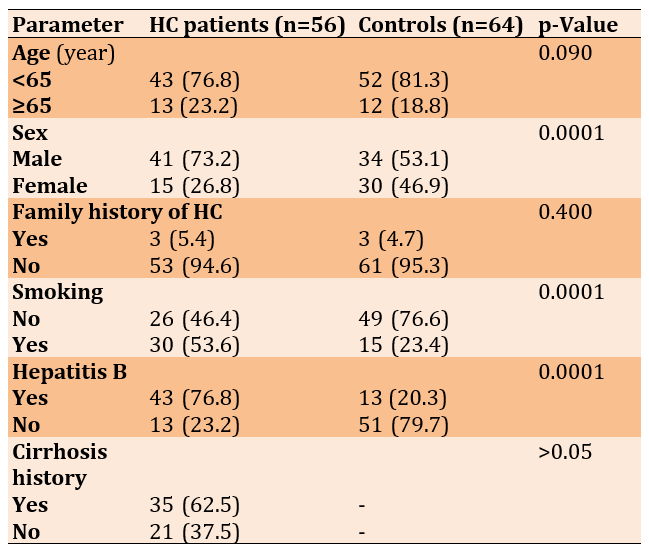
Among the 56 HC patients, 76.8% were younger than 65 years, compared with 81.3% of the 64 controls (p=0.090). Smoking was reported in 53.6% of patients and 23.4% of controls, while hepatitis B infection occurred in 76.8% and 20.3%, respectively (both p=0.0001). A family history of HC was similar between groups (p=0.400; Table 1).
Table 1. Frequency of characteristics of hepatic carcinoma (HC) patients and controls
Genotype frequencies for the three CD35 polymorphisms were assessed in 56 patients with HC and 64 healthy controls. The genotype distributions among controls conformed to Hardy–Weinberg equilibrium. No significant differences were observed between the two groups for rs2296160 or rs3849266. For rs2296160, the AG genotype was observed in 41 patients (73.2%) and 34 controls (53.1%), whereas the corresponding combined category included 15 patients (26.8%) and 30 controls (46.9%); the reported p-values were 0.40 and 0.70, respectively. Similarly, the CT genotype of rs3849266 occurred in 26 patients (46.4%) and 49 controls (76.6%), while the combined category comprised 30 patients (53.6%) and 15 controls (23.4%), with p-values of 0.50 and 0.60, respectively, (Table 2).
Table 2. Reference single-nucleotide polymorphisms (SNPs) of CD35 protein-gene in hepatic carcinoma (HC) patients and controls
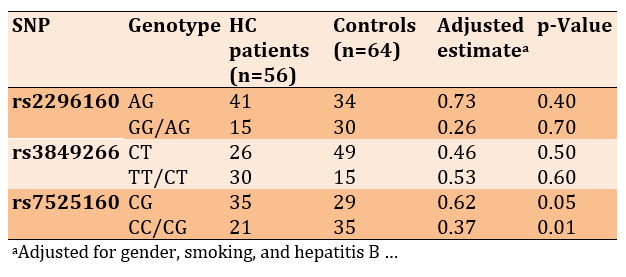
In contrast, rs7525160 showed evidence of an association with HC. The CG genotype was detected in 35 patients (62.5%) and 29 controls (45.3%), whereas the combined CC/CG category included 21 patients (37.5%) and 35 controls (54.7%). After adjustment for sex, smoking, and hepatitis B infection, the association remained statistically significant for the combined genotype category (p=0.01), while the corresponding single-genotype comparison was borderline (p=0.05). Subgroup analyses indicated that the rs7525160 C-allele association was more pronounced among patients with adverse clinical features, including tumors larger than 5cm, TNM stage III/IV disease, cirrhosis, portal vein thrombosis, and AFP concentrations exceeding 400ng/mL.
Discussion
This research examined the association between tag SNPs in CD35 and susceptibility to HC, as well as postoperative recurrence, to further knowledge of gene–environment interactions in HC Chronic inflammation and the complement cascade—together with immunological and inflammatory responses—contribute to cancer development.
Innate immunity depends on CD35, also known as complement receptor 1 (CR1), which suppresses the C3 and C5 convertases in both the classical and alternative pathways to mitigate inflammation and limit activation of the complement cascade [24]. Additionally, CD35 facilitates the degradation and clearance of complement-opsonized immune complexes, thereby helping to maintain immune-system homeostasis.
By regulating complement activation, CD35 may influence the balance between effective tumor surveillance and persistent, inflammation-associated tissue injury. Genetic polymorphisms that alter CD35 expression, receptor function, or ligand binding could therefore modify complement-mediated immune responses and affect tumor initiation or progression. In the tumor microenvironment, dysregulated complement activity may promote chronic inflammation, angiogenesis, immune evasion, and tumor-cell survival. Therefore, it is not implausible that CD35 genetic polymorphisms in the complement system could increase the risk of cancer. Polymorphisms of the CD35 gene have been shown to be significantly associated with a wide range of cancers, including ovarian, small cell lung, nasopharyngeal, gallbladder, bladder, non-Hodgkin’s lymphoma, and gastric cancers, in many studies [25, 26].
However, the direction and clinical relevance of these associations may vary according to the specific variant, cancer type, and environmental or host-related factors. Further functional studies are needed to determine whether these polymorphisms directly influence CD35 expression or activity and to clarify their contribution to cancer susceptibility and prognosis [25, 26].
Not much is known about the link between CD35 polymorphisms and HC. However, we found the first evidence of an association between HC risk and one of the three CD35 tag SNPs (rs7525160) in an Iraqi sample. It should be noted that, compared with the GG genotype, the CC/CG genotype of CD35 rs7525160 was associated with a higher risk of HC development. Thus, rs7525160 may influence complement regulation and thereby contribute to tumor initiation or progression. Genetic mutation-related diseases tend to manifest at younger ages. This is because, as demonstrated in multiple studies involving young patients [27], the interplay between genes and the environment may enhance sensitivity to cancerous tumors. Our results supported recent findings that the CD35 rs7525160 CC/CG genotype enhances HC in individuals under 60. The observed age-related association may help identify younger individuals who could benefit from more intensive surveillance, particularly when other risk factors are present. Better treatment and screening of high-risk groups have reduced recurrence and mortality [28], but HC is still the second leading cause of cancer deaths worldwide [29]. There have been reports of AFP, tumor number, and tumor size as prognostic parameters for liver cancer; however, no practical indicators have been discovered as of yet [30, 31]. Therefore, CD35 rs7525160 may have potential as an additional genetic marker for risk stratification and prognostic assessment. Nevertheless, these findings require confirmation in larger, multiethnic cohorts and through functional studies examining the effect of this variant on CD35 expression and complement activity [30, 31].
Additionally, the subgroup analysis showed a significant difference in the genotype frequency of the CD35 rs7525160 C allele between the control group and HC patients. Tumor sizes above 5cm, TNM stages III/IV, cirrhosis, portal vein thrombosis, and AFP values over 400ng/ml were notably indicative of this difference. This data point to a possible association between the CC/CG genotype of CD rs7525160 and the type of HC associated with a poor prognosis [32]. We limited our analysis to 56 untreated patients who underwent hepatectomy to exclude the impact of different therapies on HC prognosis. Our focus was on the association of CD35 with RFS/OS. Using Cox analysis, we demonstrated that rs7525160 stood out as a distinct factor predicting RFS in HC patients.
The subgroup analysis further suggested that the association between the rs7525160 C allele and HC was more evident among patients with unfavorable clinical characteristics, including tumor size greater than 5cm, advanced TNM stage (III/IV), cirrhosis, portal vein thrombosis, and serum alpha-fetoprotein (AFP) levels greater than 400ng/mL. Thus, the rs7525160 C allele may be associated not only with susceptibility to HC but also with selected clinical and tumor-related features. Nevertheless, because these subgroup analyses may involve smaller sample sizes and multiple comparisons, the results should be interpreted cautiously and confirmed in larger studies.
A significant association was identified between the CD35 rs7525160 CC/CG genotype and reduced mean RFS in HC patients. We found no association between CD35 polymorphism and overall survival (OS). This may be because several parameters, including the patient’s socioeconomic status and the therapy selected after recurrence, affect both OS and the postoperative recurrence of HC. Many issues remain to be addressed in this research. Additionally, we limited our results to the Iraqi population. However, substantial ethnic differences exist in the allele-frequency patterns of CD35 polymorphism; therefore, our results may not be applicable to other populations. Second, our study only examined CD35 polymorphism, HC susceptibility, and genetic prognosis; functional validation is required. Third, a larger sample size is needed to study genetic polymorphism and HC metastasis.
Conclusion
Among Iraqi participants younger than 65 years, the CD35 rs7525160 polymorphism increases hepatic carcinoma susceptibility and predicts poorer recurrence-free survival.
Acknowledgments: The authors extend their sincere thanks and gratitude to all the staff members of the Public Health & Laboratory Departments for their invaluable assistance in completing this work and their cooperation throughout the study.
Ethical Permissions: Approval number 0043 CSE, dated 10/10/2025, was obtained from the Research Ethics Committee, College of Science, University of Kerbala.
Conflicts of Interests: The authors declared no conflicts of interest.
Authors' Contribution: Jasim AH (First Author), Methodologist/Main Researcher/Discussion Writer/Statistical Analyst (60%); Ali BA (Second Author), Introduction Writer/Methodologist/Assistant Researcher (20%); Abdulbaqi M (Third Author), Introduction Writer/Methodologist/Assistant Researcher (20%)
Funding/Support: This study was supported by the Community Health & Laboratory Departments, Polytechnic College–Karbala, Al-Furat Al-Awsat Technical University, Kufa, Iraq.
Approximately 80% of primary liver malignancies are hepatocellular carcinomas (HCs), the fourth leading cause of cancer deaths worldwide [1,2]. These malignancies constitute a significant global health burden. Their high mortality rate highlights the seriousness of liver cancer. Early diagnosis is therefore essential for improving treatment outcomes. Developing effective strategies for prevention, detection, and management remains a major clinical priority. The burden of HCs is particularly pronounced in regions with a high prevalence of chronic hepatitis B and hepatitis C virus infections [3-5]. Other important risk factors include cirrhosis, excessive alcohol consumption, metabolic dysfunction-associated steatotic liver disease, obesity, diabetes, and exposure to aflatoxins. Because HCs often develop in patients with pre-existing liver disease, symptoms may remain absent until the tumor has reached an advanced stage. Consequently, many patients are diagnosed when curative interventions, such as surgical resection, liver transplantation, or local ablation, are no longer feasible. Although surveillance programs and advances in imaging have improved early detection, disparities in healthcare access continue to limit their effectiveness. Furthermore, recurrence after treatment remains common and substantially reduces long-term survival. A better understanding of the genetic and environmental factors that influence HC development and recurrence is therefore necessary to support earlier diagnosis, individualized risk assessment, and more effective therapeutic strategies [6].
Risk factors for liver cancer include alcohol consumption, tobacco use, aflatoxin exposure, obesity, diabetes, non-alcoholic fatty liver disease (NAFLD), and infection with hepatitis B virus (HBV) or hepatitis C virus (HCV). These factors can contribute to chronic liver injury, inflammation, fibrosis, and, ultimately, malignant transformation. However, they do not fully account for the development of hepatic carcinomas (HCs), as some individuals develop the disease in the absence of clearly established risk factors. This observation suggests that host-related factors may also influence individual susceptibility to liver cancer. Genetic parameters associated with HC vulnerability have been identified in numerous studies [7, 8]. Such genetic differences may affect pathways involved in carcinogen metabolism, immune responses, DNA repair, and cellular growth. Further investigation of these factors may improve risk assessment and support the development of personalized prevention and treatment strategies. These findings highlight the important role of genetic factors in the development of hepatic carcinoma (HC). Genetic alterations may influence tumor initiation, progression, metastasis, and responses to treatment. Therefore, a comprehensive understanding of the molecular pathways regulating HC growth and development is essential. Investigating these pathways may help identify key biomarkers for early diagnosis and disease monitoring. It may also reveal novel therapeutic targets for the development of more effective treatment options [9]. In addition, integrating genetic and molecular information could improve patient stratification and support personalized treatment strategies. Such advances may ultimately contribute to better clinical outcomes and reduced mortality among patients with HC.
The complement system contributes to tissue regeneration, lipid metabolism, and the clearance of immune complexes. It has traditionally been regarded as a first line of defense against microbial pathogens [10]. Complement activation promotes the recognition and elimination of foreign organisms through coordinated inflammatory and immune responses. However, increasing evidence suggests that complement signaling can also influence the tumor microenvironment. Several studies have shown that persistent complement activation may promote tumor development by supporting sustained cellular proliferation, reducing apoptosis, and enhancing invasion and metastasis [11–13]. Complement components may additionally regulate interactions between tumor cells, stromal cells, and immune cells. These effects can facilitate tumor progression and contribute to resistance against immune-mediated elimination. Therefore, understanding the dual role of the complement system in host defense and cancer progression may help identify novel biomarkers and therapeutic targets.
The complement system depends on the liver more than on any other organ [14]. The liver is the primary site for the synthesis and secretion of many complement components into the circulation. Consequently, liver damage may significantly alter complement production, activation, and regulation. Liver injury, regeneration, and transplantation are among the several liver-related processes influenced by complement activity [15]. Complement activation is regulated by a large family of complement regulatory proteins that help maintain a balance between effective immune defense and excessive inflammation [16]. Complement receptor 1 (CR1/CD35; abbreviated CD35) is notable for its established role in immunological regulation involving T cells and B cells. It also binds the complement fragments C3b and C4b, thereby facilitating the clearance of immune complexes and enhancing neutrophil-mediated phagocytosis [17,18]. CD35 is expressed on several immune and blood cells, including erythrocytes, B cells, and phagocytic cells. On erythrocytes, CD35 contributes to the
transport of complement-opsonized immune complexes to the liver and spleen for removal from the circulation. This function helps prevent the prolonged deposition of immune complexes in tissues. Altered CD35 expression or activity may therefore contribute to persistent inflammation and impaired immune surveillance. Within the tumor microenvironment, complement signaling can influence interactions among malignant cells, stromal cells, and infiltrating immune cells. Dysregulated complement activity may support tumor-cell survival, angiogenesis, invasion, and resistance to immune-mediated elimination. Genetic polymorphisms in the CD35 gene may modify receptor expression, ligand binding, or downstream immune responses. These variations could interact with environmental factors, including chronic viral infection, inflammation, smoking, alcohol consumption, and dietary exposures, to influence HC susceptibility. The relationship between CD35 polymorphisms and HC susceptibility remains poorly understood. The current case-control study examined HC susceptibility and recurrence and identified CD35 single-nucleotide polymorphisms (SNPs) to investigate how gene–environment interactions influence HC risk. Characterizing these associations may improve understanding of the genetic mechanisms underlying HC development. Such information could also assist in identifying individuals at increased risk of disease or recurrence. In addition, CD35-related biomarkers may eventually contribute to early detection, prognostic assessment, and personalized treatment strategies [19-23].
This research sought to examine the association between tag SNPs in CD35 and susceptibility to HC, as well as postoperative recurrence, to further knowledge of gene–environment interactions in HC. Investigating these genetic variants is important because CD35 plays a central role in complement regulation, immune-complex clearance, and inflammatory responses. Identifying CD35 polymorphisms associated with HC risk may help clarify the biological mechanisms that contribute to tumor initiation and progression. Moreover, determining whether these variants are linked to postoperative recurrence could improve risk stratification and follow-up planning for affected patients. The study may also help explain why individuals with similar environmental exposures experience different disease outcomes. Ultimately, the findings could provide a foundation for developing predictive biomarkers and more individualized strategies for HC prevention, surveillance, and treatment.
Materials and Methods
This hospital-based observational study was conducted between October 2025 and March 2026 at Al-Hussein Teaching Hospital in Kerbala, Iraq. The study included 56 patients diagnosed with HC and 64 healthy controls selected using convenience sampling.
The inclusion criteria for the HC group were aged ≥18 years, a confirmed diagnosis of HC based on clinical, laboratory, imaging, and/or histopathological findings, and willingness to participate in the study. The control group included individuals without a history of HC or other malignant diseases, who had no clinical evidence of significant liver disease and were frequency-matched to patients by age and sex. Participants who withdrew from the study or whose genetic samples were inadequate for analysis were also excluded.
At enrollment, demographic and clinical information was collected from each participant or, when necessary, from an accompanying family member. The recorded baseline characteristics included age, sex, smoking status, and family history of HC. For patients with HC, medical records, laboratory results, and imaging findings were reviewed to obtain information on tumor size, tumor number, metastasis, Child–Pugh classification, and microvascular invasion.
The Human Genome Project and the International HapMap Project provided the CD35 SNPs. We used Iraqi HapMap data with HaploView 4.2 to identify CD35 tag SNPs with a minor allele frequency (MAF) <0.05 and an r² cutoff of 0.8. We also examined three single-nucleotide polymorphisms (rs2296160, rs3849266, and rs7525160). Following the manufacturer’s instructions, the TIANamp Genomic DNA Kit (Tiangen Biotech Co. Ltd., Beijing, China) extracted genomic DNA from whole blood samples (EDTA anticoagulant). Diluted isolated DNA (20ng/mL) was stored at -20°C.
The MassARRAY system and the MALDI-TOF method were used for genotyping according to the manufacturer’s instructions. Sequenom is located in San Diego, CA, USA. Genotyping quality control confirmed genotypic consistency in 5% of randomly selected and duplicated samples. An additional 5% of samples were genotypically verified by direct sequencing.
Analyses were performed using SPSS 26. The chi-squared goodness-of-fit test evaluated the deviation of each SNP frequency from Hardy-Weinberg equilibrium (HWE) within the control group. We used a Mann-Whitney U test for continuous parameters and a chi-square test with Fisher’s exact test for categorical parameters to compare the demographics of the HC and control groups.
A logistic regression model linked HC risk to the CD35 tag SNP. Sex, HBV status, smoking, and alcohol intake were significant parameters in the OR and 95% CI. A Cox proportional hazards model and univariate survival analysis were used to investigate RFS/OS and CD35 tag SNPs.
Findings
Among the 56 HC patients, 76.8% were younger than 65 years, compared with 81.3% of the 64 controls (p=0.090). Smoking was reported in 53.6% of patients and 23.4% of controls, while hepatitis B infection occurred in 76.8% and 20.3%, respectively (both p=0.0001). A family history of HC was similar between groups (p=0.400; Table 1).
Table 1. Frequency of characteristics of hepatic carcinoma (HC) patients and controls
Genotype frequencies for the three CD35 polymorphisms were assessed in 56 patients with HC and 64 healthy controls. The genotype distributions among controls conformed to Hardy–Weinberg equilibrium. No significant differences were observed between the two groups for rs2296160 or rs3849266. For rs2296160, the AG genotype was observed in 41 patients (73.2%) and 34 controls (53.1%), whereas the corresponding combined category included 15 patients (26.8%) and 30 controls (46.9%); the reported p-values were 0.40 and 0.70, respectively. Similarly, the CT genotype of rs3849266 occurred in 26 patients (46.4%) and 49 controls (76.6%), while the combined category comprised 30 patients (53.6%) and 15 controls (23.4%), with p-values of 0.50 and 0.60, respectively, (Table 2).
Table 2. Reference single-nucleotide polymorphisms (SNPs) of CD35 protein-gene in hepatic carcinoma (HC) patients and controls
In contrast, rs7525160 showed evidence of an association with HC. The CG genotype was detected in 35 patients (62.5%) and 29 controls (45.3%), whereas the combined CC/CG category included 21 patients (37.5%) and 35 controls (54.7%). After adjustment for sex, smoking, and hepatitis B infection, the association remained statistically significant for the combined genotype category (p=0.01), while the corresponding single-genotype comparison was borderline (p=0.05). Subgroup analyses indicated that the rs7525160 C-allele association was more pronounced among patients with adverse clinical features, including tumors larger than 5cm, TNM stage III/IV disease, cirrhosis, portal vein thrombosis, and AFP concentrations exceeding 400ng/mL.
Discussion
This research examined the association between tag SNPs in CD35 and susceptibility to HC, as well as postoperative recurrence, to further knowledge of gene–environment interactions in HC Chronic inflammation and the complement cascade—together with immunological and inflammatory responses—contribute to cancer development.
Innate immunity depends on CD35, also known as complement receptor 1 (CR1), which suppresses the C3 and C5 convertases in both the classical and alternative pathways to mitigate inflammation and limit activation of the complement cascade [24]. Additionally, CD35 facilitates the degradation and clearance of complement-opsonized immune complexes, thereby helping to maintain immune-system homeostasis.
By regulating complement activation, CD35 may influence the balance between effective tumor surveillance and persistent, inflammation-associated tissue injury. Genetic polymorphisms that alter CD35 expression, receptor function, or ligand binding could therefore modify complement-mediated immune responses and affect tumor initiation or progression. In the tumor microenvironment, dysregulated complement activity may promote chronic inflammation, angiogenesis, immune evasion, and tumor-cell survival. Therefore, it is not implausible that CD35 genetic polymorphisms in the complement system could increase the risk of cancer. Polymorphisms of the CD35 gene have been shown to be significantly associated with a wide range of cancers, including ovarian, small cell lung, nasopharyngeal, gallbladder, bladder, non-Hodgkin’s lymphoma, and gastric cancers, in many studies [25, 26].
However, the direction and clinical relevance of these associations may vary according to the specific variant, cancer type, and environmental or host-related factors. Further functional studies are needed to determine whether these polymorphisms directly influence CD35 expression or activity and to clarify their contribution to cancer susceptibility and prognosis [25, 26].
Not much is known about the link between CD35 polymorphisms and HC. However, we found the first evidence of an association between HC risk and one of the three CD35 tag SNPs (rs7525160) in an Iraqi sample. It should be noted that, compared with the GG genotype, the CC/CG genotype of CD35 rs7525160 was associated with a higher risk of HC development. Thus, rs7525160 may influence complement regulation and thereby contribute to tumor initiation or progression. Genetic mutation-related diseases tend to manifest at younger ages. This is because, as demonstrated in multiple studies involving young patients [27], the interplay between genes and the environment may enhance sensitivity to cancerous tumors. Our results supported recent findings that the CD35 rs7525160 CC/CG genotype enhances HC in individuals under 60. The observed age-related association may help identify younger individuals who could benefit from more intensive surveillance, particularly when other risk factors are present. Better treatment and screening of high-risk groups have reduced recurrence and mortality [28], but HC is still the second leading cause of cancer deaths worldwide [29]. There have been reports of AFP, tumor number, and tumor size as prognostic parameters for liver cancer; however, no practical indicators have been discovered as of yet [30, 31]. Therefore, CD35 rs7525160 may have potential as an additional genetic marker for risk stratification and prognostic assessment. Nevertheless, these findings require confirmation in larger, multiethnic cohorts and through functional studies examining the effect of this variant on CD35 expression and complement activity [30, 31].
Additionally, the subgroup analysis showed a significant difference in the genotype frequency of the CD35 rs7525160 C allele between the control group and HC patients. Tumor sizes above 5cm, TNM stages III/IV, cirrhosis, portal vein thrombosis, and AFP values over 400ng/ml were notably indicative of this difference. This data point to a possible association between the CC/CG genotype of CD rs7525160 and the type of HC associated with a poor prognosis [32]. We limited our analysis to 56 untreated patients who underwent hepatectomy to exclude the impact of different therapies on HC prognosis. Our focus was on the association of CD35 with RFS/OS. Using Cox analysis, we demonstrated that rs7525160 stood out as a distinct factor predicting RFS in HC patients.
The subgroup analysis further suggested that the association between the rs7525160 C allele and HC was more evident among patients with unfavorable clinical characteristics, including tumor size greater than 5cm, advanced TNM stage (III/IV), cirrhosis, portal vein thrombosis, and serum alpha-fetoprotein (AFP) levels greater than 400ng/mL. Thus, the rs7525160 C allele may be associated not only with susceptibility to HC but also with selected clinical and tumor-related features. Nevertheless, because these subgroup analyses may involve smaller sample sizes and multiple comparisons, the results should be interpreted cautiously and confirmed in larger studies.
A significant association was identified between the CD35 rs7525160 CC/CG genotype and reduced mean RFS in HC patients. We found no association between CD35 polymorphism and overall survival (OS). This may be because several parameters, including the patient’s socioeconomic status and the therapy selected after recurrence, affect both OS and the postoperative recurrence of HC. Many issues remain to be addressed in this research. Additionally, we limited our results to the Iraqi population. However, substantial ethnic differences exist in the allele-frequency patterns of CD35 polymorphism; therefore, our results may not be applicable to other populations. Second, our study only examined CD35 polymorphism, HC susceptibility, and genetic prognosis; functional validation is required. Third, a larger sample size is needed to study genetic polymorphism and HC metastasis.
Conclusion
Among Iraqi participants younger than 65 years, the CD35 rs7525160 polymorphism increases hepatic carcinoma susceptibility and predicts poorer recurrence-free survival.
Acknowledgments: The authors extend their sincere thanks and gratitude to all the staff members of the Public Health & Laboratory Departments for their invaluable assistance in completing this work and their cooperation throughout the study.
Ethical Permissions: Approval number 0043 CSE, dated 10/10/2025, was obtained from the Research Ethics Committee, College of Science, University of Kerbala.
Conflicts of Interests: The authors declared no conflicts of interest.
Authors' Contribution: Jasim AH (First Author), Methodologist/Main Researcher/Discussion Writer/Statistical Analyst (60%); Ali BA (Second Author), Introduction Writer/Methodologist/Assistant Researcher (20%); Abdulbaqi M (Third Author), Introduction Writer/Methodologist/Assistant Researcher (20%)
Funding/Support: This study was supported by the Community Health & Laboratory Departments, Polytechnic College–Karbala, Al-Furat Al-Awsat Technical University, Kufa, Iraq.
Keywords:
Proteins [MeSH], Genetic Variation [MeSH], Metastasis [MeSH], Disease Susceptibility [MeSH], Hepatic Cancer [MeSH]
References
1. Yang JD, Hainaut P, Gores GJ, Amadou A, Plymoth A, Roberts LR. A global view of hepatocellular carcinoma: Trends, risk, prevention and management. Nat Rev Gastroenterol Hepatol. 2019;16(10):589-604. [Link] [DOI:10.1038/s41575-019-0186-y]
2. Fitzmaurice C, Allen C, Barber RM, Barregard L, Bhutta ZA, Brenner H, et al. Global, regional, and national cancer incidence, mortality, years of life lost, years lived with disability, and disability-adjusted life-years for 32 cancer groups, 1990 to 2015: A systematic analysis for the Global Burden of Disease Study. JAMA Oncol. 2017;3(4):524-48. [Link] [DOI:10.1001/jamaoncol.2016.5688]
3. Ding C, Fu X, Zhou Y, Liu X, Wu J, Huang C, et al. Disease burden of liver cancer in China from 1997 to 2016: An observational study based on the Global Burden of Diseases. BMJ Open. 2019;9(4):e025613. [Link] [DOI:10.1136/bmjopen-2018-025613]
4. ChenW, Zheng R, Baade PD, Zhang S, ZengH, Bray F, et al. Cancer statistics in China, 2015. CA Cancer J Clin. 2016;66(2):115-32. [Link] [DOI:10.3322/caac.21338]
5. Yang JD, Mohamed HA, Cvinar JL, Gores GJ, Roberts LR, Kim WR. Diabetes mellitus heightens the risk of hepatocellular carcinoma except in patients with hepatitis C cirrhosis. Am J Gastroenterol. 2016;111(11):1573-80. [Link] [DOI:10.1038/ajg.2016.330]
6. Chayanupatkul M, Omino R, Mittal S, Kramer JR, Richardson P, Thrift AP, et al. Hepatocellular carcinoma in the absence of cirrhosis in patients with chronic hepatitis B virus infection. J Hepatol. 2017;66(2):355-62. [Link] [DOI:10.1016/j.jhep.2016.09.013]
7. Younossi ZM, Koenig AB, Abdelatif D, Fazel Y, Henry L, Wymer M. Global epidemiology of nonalcoholic fatty liver disease-meta-analytic assessment of prevalence, incidence, and outcomes. Hepatology. 2016;64(1):73-84. [Link] [DOI:10.1002/hep.28431]
8. El-Serag HB, Hampel H, Javadi F. The association between diabetes and hepatocellular carcinoma: A systematic review of epidemiologic evidence. Clin Gastroenterol Hepatol. 2006;4(3):369-80. [Link] [DOI:10.1016/j.cgh.2005.12.007]
9. Huang SF, Chang IC, Hong CC, Yen TC, Chen CL, Wu CC, et al. Metabolic risk factors are associated with non-hepatitis B non-hepatitis C hepatocellular carcinoma in Taiwan, an endemic area of chronic hepatitis B. Hepatol Commun. 2018;2(6):747-59. [Link] [DOI:10.1002/hep4.1182]
10. Zhang C, Ye Z, Zhang Z, Zheng J, Tang Y, Hou E, et al. A comprehensive evaluation of single nucleotide polymorphisms associated with hepatocellular carcinoma risk in Asian populations: A systematic review and network meta-analysis. Gene. 2020;735:144365. [Link] [DOI:10.1016/j.gene.2020.144365]
11. Clifford RJ, Zhang J, Meerzaman DM, Lyu MS, Hu Y, Cultraro CM, et al. Genetic variations at loci involved in the immune response are risk factors for hepatocellular carcinoma. Hepatology. 2010;52(6):2034-43. [Link] [DOI:10.1002/hep.23943]
12. Liu F, Li F, Luo L, Yang H, Wei Y, Wang W, et al. Genetic variants in cell death pathway genes and HBV-related hepatocellular carcinoma among a Chinese Han population. Apoptosis. 2017;22(8):1035-47. [Link] [DOI:10.1007/s10495-017-1385-z]
13. Jasim AH, Altememy D. Comparison of chemotherapy effectiveness between cancer patients with and without dependent dose of radiotherapy. Iran J War Public Health. 2024;16(3):289-94. [Link]
14. Shen FM, Lee MK, Gong HM, Cai XQ, King MC. Complex segregation analysis of primary hepatocellular carcinoma in Chinese families: Interaction of inherited susceptibility and hepatitis B viral infection. Am J Hum Genet. 1991;49(1):88-93. [Link]
15. An P, Xu J, Yu Y, Winkler CA. Host and viral genetic variation in HBV-related hepatocellular carcinoma. Front Genet. 2018;9:261. [Link] [DOI:10.3389/fgene.2018.00261]
16. Sunyer JO, Zarkadis IK, Lambris JD. Complement diversity: A mechanism for generating immune diversity?. Immunol Today. 1998;19(11):519-23. [Link] [DOI:10.1016/S0167-5699(98)01341-3]
17. Rutkowski MJ, Sughrue ME, Kane AJ, Mills SA, Parsa AT. Cancer and the complement cascade. Mol Cancer Res. 2010;8(11):1453-65. [Link] [DOI:10.1158/1541-7786.MCR-10-0225]
18. Markiewski MM, Lambris JD. Is complement good or bad for cancer patients? A new perspective on an old dilemma. Trends Immunol. 2009;30(6):286-92. [Link] [DOI:10.1016/j.it.2009.04.002]
19. Reis ES, Mastellos DC, Ricklin D, Mantovani A, Lambris JD. Complement in cancer: Untangling an intricate relationship. Nat Rev Immunol. 2018;18(1):5-18. [Link] [DOI:10.1038/nri.2017.97]
20. Qin X, Gao B. The complement system in liver diseases. Cell Mol Immunol. 2006;3(5):333-40. [Link]
21. Thorgersen EB, Barratt-Due A, Haugaa H, Harboe M, Pischke SE, Nilsson PH, et al. The role of complement in liver injury, regeneration, and transplantation. Hepatology. 2019;70(2):725-36. [Link] [DOI:10.1002/hep.30508]
22. Noris M, Remuzzi G. Overview of complement activation and regulation. Semin Nephrol. 2013;33(6):479-92. [Link] [DOI:10.1016/j.semnephrol.2013.08.001]
23. Krych-Goldberg M, Atkinson JP. Structure-function relationships of complement receptor type 1. Immunol Rev. 2001;180(1):112-22. [Link] [DOI:10.1034/j.1600-065X.2001.1800110.x]
24. Ricklin D, Hajishengallis G, Yang K, Lambris JD. Complement: A key system for immune surveillance and homeostasis. Nat Immunol. 2010;11(9):785-97. [Link] [DOI:10.1038/ni.1923]
25. Yu X, Rao J, Lin J, Zhang Z, Cao L, Zhang X. Tag SNPs in complement receptor-1 contribute to the susceptibility to non-small cell lung cancer. Mol Cancer. 2014;13:56. [Link] [DOI:10.1186/1476-4598-13-56]
26. He JR, Xi J, Ren ZF, Qin H, Zhang Y, Zeng YX, et al. Complement receptor 1 expression in peripheral blood mononuclear cells and the association with clinicopathological features and prognosis of nasopharyngeal carcinoma. Asian Pac J Cancer Prev. 2012;13(12):6527-31. [Link] [DOI:10.7314/APJCP.2012.13.12.6527]
27. Srivastava A, Mittal B. Complement receptor 1 (A3650G RsaI and Intron 27 HindIII) polymorphisms and risk of gallbladder cancer in North Indian population. Scand J Immunol. 2009;70(6):614-20. [Link] [DOI:10.1111/j.1365-3083.2009.02329.x]
28. Luo L, Li Q, Su Z, Li L, Cai B, Peng Y, et al. Genetic polymorphisms in CD35 gene contribute to the susceptibility and prognosis of hepatocellular carcinoma. Front Oncol. 2021;11:700711. [Link] [DOI:10.3389/fonc.2021.700711]
29. European Association for the Study of the Liver. EASL clinical practice guidelines: Management of hepatocellular carcinoma. J Hepatol. 2018;69(1):182-236. [Link]
30. Edge SB, Byrd DR, Compton CC, Fritz AG, Greene FL, Trotti A, editors. AJCC cancer staging manual. 7th ed. New York: Springer; 2010. [Link]
31. Al-Joda BM, Jasim AH. A comparative evaluation of calcitonin and carcinoembryonic antigen levels with chemotherapy for gastrointestinal cancer patients in Kerbala governorate. Int J Drug Deliv Technol. 2021;11(1):106-8. [Link]
32. Pasic I, Wong KM, Lee JJ, Espin-Garcia O, Brhane Y, Cheng D, et al. Two BRM promoter polymorphisms predict poor survival in patients with hepatocellular carcinoma. Mol Carcinog. 2018;57(1):106-13. [Link] [DOI:10.1002/mc.22736]